Dr. Jean Stepter-Gray, in March 2003, she heard a Word from God, saying it’s time to elevate! She prayed with exuberance to God to be a woman of faith, who would inspire others to be great, she says, “If she had known that this journey would have taken her through so many seasons, she would have packed lighter! But thanks be unto God, for He is answering her prayers, one season at a time. (Smiling)
Jean serves as Minister, Mentor, Speaker, Teacher, Chaplain Licensed and Board-Certified /Therapist Christian Counselor and has experienced so much of God’s love, mercy, grace, and favor; and she wants to share it with anyone who truly desires it. Her goal is to ignite in women and men a passion for the Word of God so that they can see the beauty of Jesus Christ, so that they may have a personal relationship with Him. She believes that it is through personal interactions with God and His Word that we will grow.
Jean believes that God gave her gifts to share with others for His Glory. She uses her natural gift as a communicator and practical teaching style to serve others. She says that her grandmother use to tell her, “The people around you reap the benefits of you serving God”, which means that you won’t go to God in any old way, you go to Him correctly!
Jean’s ultimate desire is to help one somebody know that it does not matter the path that it took you to get here, but it is the journey that God is using to get you to your next destination! Let’s embrace our new journey of being
Transformed at the Well and drinking from wells that we did not dig!
To God be the Glory!
Isaiah 43:18–19 (NIV) “Forget the former things; do not dwell on the past. See, I am doing a new thing! Now it springs up; do you not perceive it? I am making a way in the wilderness and streams in the wasteland.”
You need to remember God’s faithfulness without remaining in the past. In Isaiah 43, God speaks to Israel through the prophet Isaiah, reminding His people that He is their Creator, Redeemer, and the One who has called them by name. The chapter addresses a people who had experienced disobedience, judgment, and hardship, yet God declares that His redemptive purposes have not ended. In verses 16–17, He reminds them of His mighty deliverance through the sea, recalling how He made a way for Israel when the Egyptian army pursued them.
Please re-read verses 18–19, God declares, “Remember ye not the former things, neither consider the things of old. Behold, I will do a new thing.” Notice that God reminds His people of what He has done before instructing them not to remain occupied with former things. He is not commanding them to forget His faithfulness or erase their history. Instead, He is teaching them not to become so focused on His previous works that they fail to recognize what He is preparing to do in their present circumstances.
The God who once made a way through the sea was now declaring that He could make a way in the wilderness and provide rivers in the desert. His power had not changed, but the circumstances in which His people would experience His provision would be different. This passage teaches an important spiritual principle: You can remember what God has done without demanding that everything He does next look exactly like yesterday.
Philippians 3:13–14 reinforces this truth. The apostle Paul speaks about forgetting what is behind and reaching toward what lies ahead. Paul had a past filled with both religious accomplishments and painful mistakes, including his persecution of believers before encountering Jesus Christ. Yet he refused to allow his former identity, achievements, or failures to become the controlling focus of his relationship with Christ. Paul was not suggesting that believers should erase their memories. He was teaching the importance of refusing to allow the past to prevent continued spiritual growth. Together, these passages remind you that your history may contain valuable lessons and powerful testimonies, but it should not become a place where you remain emotionally or spiritually confined.
Have you ever awakened to a morning when the mist was so thick that you could barely see what was beyond your window? You knew the trees were still standing, the roadway was still there, and the landscape had not disappeared, but the mist prevented you from seeing everything clearly. Then, as the morning progressed, the mist slowly began to lift, and what had been hidden gradually came into view.
Sometimes your life can resemble that mist-covered morning. You may be moving through a new day while still carrying the emotional weight of something that happened yesterday. Perhaps it was a disappointment, a relationship that changed, a decision you regret, an opportunity that ended, or a season you were not ready to release. Although time has passed, the memory continues to influence your thoughts, expectations, and responses.
During the first two days of our devotional journey, we learned to surrender tomorrow and recognize the preciousness of the time God has entrusted to us. James 4:14 reminds us that life is like a vapor, appearing for a little while and then vanishing away. But today, we must examine something that can quietly rob us of the very moments we have been encouraged to value. Sometimes you are not missing today because you are worried about tomorrow. Sometimes you are missing today because you are still living in yesterday. You can be physically present in a new season while remaining emotionally attached to an old one. You can continue fulfilling your responsibilities, caring for others, serving in ministry, and moving through your daily routine while privately rehearsing something you wish had happened differently. Your life may have moved forward, but your thoughts continually return to a moment you cannot change. And the longer you remain focused on what happened, the more difficult it may become to recognize what is happening now.
You cannot look at tomorrow with yesterday’s lenses. Sometimes you do not realize how much your past has influenced your present until you examine the way you respond to people and circumstances. Perhaps someone betrayed your trust, and now you approach new relationships expecting disappointment. Maybe you experienced rejection, and you find yourself questioning whether you are truly accepted even when others demonstrate genuine care. Perhaps you made a mistake in an earlier season, and although you have grown and learned from it, you continue defining yourself by that moment. You may have experienced a disappointment so significant that every new opportunity is measured against the possibility of being disappointed again. In these situations, yesterday has become the lens through which you interpret today.
This does not mean your experiences were insignificant or that the pain you endured should be ignored. Some experiences require time, prayer, wise counsel, and intentional healing. Releasing yesterday does not mean pretending something never happened, denying injustice, or returning to harmful circumstances. It means learning to distinguish between the wisdom you gained from an experience and the emotional burden you may still be carrying because of it; but you can carry the lessons of yesterday without allowing yesterday to control your present.
Perhaps your past taught you the importance of boundaries, discernment, patience, or forgiveness. Those lessons may be necessary for your growth. But you do not have to allow fear, resentment, shame, or disappointment to determine every decision you make moving forward. God can use what you have learned to strengthen your wisdom without requiring you to remain imprisoned by the experience itself. Ecclesiastes 3:1 declares, “To everything there is a season, and a time to every purpose under the heaven.” This scripture reminds you that life unfolds through different seasons, each with its own experiences, responsibilities, and changes. There may be a season of your life that you remember with great affection. Perhaps it was a time when your family was together in a particular way, your responsibilities were different, your relationships seemed simpler, or an assignment brought you tremendous fulfillment. You may find yourself wishing you could return to that period because it was familiar and meaningful. But sometimes you can become so attached to what was that you struggle to appreciate what is.
There is nothing wrong with remembering meaningful experiences or thanking God for what He has done. The difficulty begins when yesterday becomes the standard against which every present experience must be measured. You may be waiting for God to repeat a former blessing while overlooking the ways He is sustaining you now. You may be longing for a previous season while neglecting the opportunities available in this one. Isaiah 43:19 reminds you that God’s faithfulness is not limited to the methods He used before. His declaration of a new thing to Israel was rooted in His redemptive purposes for His people, and it reminds us that God is not confined to our expectations of how He must work. Do not become so attached to yesterday’s experience that you overlook today’s opportunity to trust God.
Philippians 3:13–14 reminds you that Paul was determined to press toward the calling of God in Christ Jesus. He understood that spiritual growth required him to continue moving forward rather than allowing his former achievements or failures to become the center of his attention. You may have moments in your past that you wish you could change. Perhaps you spoke too quickly, trusted someone unwisely, missed an opportunity, or made a decision without seeking God’s direction. You may have learned valuable lessons through those experiences, yet you continue revisiting them with regret. But regret alone cannot change what has already happened.
If a past decision requires repentance, an apology, restitution, or another responsible action, seek God’s wisdom and respond appropriately. If the matter can no longer be changed, ask Him to help you receive the lesson without continually punishing yourself for the experience. Second Corinthians 5:17 reminds believers that those who are in Christ are a new creation. Your identity is rooted in your relationship with Jesus Christ, not solely in your former mistakes, disappointments, or accomplishments.
This does not mean every consequence disappears immediately or that healing happens overnight. It means that your past does not have to become the final authority over who you are becoming in Christ. You can acknowledge what happened, learn what needs to be learned, and continue growing without allowing shame to define your future. A wonderful thing takes place when God’s Mercy meets you in your present. Lamentations 3:21–23 was written in the context of deep suffering and grief, yet the writer deliberately recalls the Lord’s compassion and faithfulness. He declares that God’s mercies are new every morning and that His compassions do not fail.
Consider the significance of that truth. Yesterday may have contained disappointment, difficulty, or regret, but God’s mercy has not been exhausted. You may have awakened with memories that still trouble your heart, yet you can come before Him and receive the grace necessary for today. You do not have to pretend that your past never happened to experience God’s sustaining Presence now. Perhaps you are still grieving something you lost. Perhaps you are learning how to trust again. Perhaps you are adjusting to circumstances you never expected. Whatever the situation is, God is inviting you to bring your concerns before Him rather than allowing them to consume your present. His mercy does not require you to deny your emotions. It reminds you that your emotions do not have to become the only truth governing your life. As you continue seeking healing, you can acknowledge your pain while remaining open to the goodness God has placed around you.
When the mist clears, what will you choose to see? As you return to the image of the morning mist, remember that the mist did not erase the landscape. It simply limited your ability to see what was already there. Sometimes yesterday’s disappointments can have a similar effect. You may be so focused on what ended that you overlook what remains. You may be so occupied with what you lost that you struggle to appreciate what God has preserved. You may be so concerned about what should have happened that you miss the opportunities available to you now. And perhaps the prayer you need to begin praying is, “Father, help me see my present without continually filtering it through my past.”
James 4:13–15 reminds you that tomorrow is uncertain and that your plans must remain submitted to God’s will. But the same humility that teaches you to surrender tomorrow should also help you release your attempts to control yesterday. You cannot rewrite what has already happened, and you cannot guarantee what lies ahead. But you can seek God’s wisdom concerning how to live faithfully today. This is why our prayer throughout this week remains so important, “Father, teach me how to live within the confines of my day, that I may flow in Your Presence in my present, and not in tomorrow nor my past, in the Name of Jesus Christ.”
You are not being asked to erase your history. You are being invited to stop allowing your history to consume your present. You can remember without continually reliving, learn without remaining ashamed, and grieve without surrendering your hope. When the mist of yesterday begins to clear, you may discover that God has been sustaining you in the present all along.
Let’s Pray:
Father, in the mighty and matchless Name of Jesus Christ, I come before You with a grateful heart, acknowledging that You are the God who has sustained me through every season of my life. Thank You for Your faithfulness in moments of celebration and Your sustaining grace during times of difficulty. Thank You that my history is not hidden from You and that Your compassion continues to meet me in the circumstances I face today. Father, as I reflect upon Your Word in Isaiah 43:18–19, help me understand what it means to release the former things without forgetting Your faithfulness. Teach me to appreciate the testimonies of yesterday without becoming so attached to the past that I fail to recognize Your goodness in the present. Forgive me for the times I have allowed former disappointments, painful memories, or missed opportunities to consume my thoughts and interrupt my peace. Lord, search my heart and reveal the places where yesterday continues to influence the way I live today. Where regret has caused me to condemn myself, lead me into repentance, responsibility, and the freedom of Your forgiveness. Where rejection has weakened my confidence, remind me of my identity in Jesus Christ. Where betrayal has affected my ability to trust, grant me wisdom, healing, and healthy discernment. Where grief remains, surround me with Your comfort and give me grace for the healing process. Father, teach me to distinguish between the lessons of my past and the burdens I was never meant to carry indefinitely. I do not want to forget what You have taught me, but neither do I want to remain imprisoned by fear, bitterness, shame, or disappointment. Help me receive the wisdom gained through my experiences while releasing the unnecessary weight that continues to affect my present. Lord, forgive me for comparing every new season with what I experienced before. Forgive me for expecting You to move in exactly the same way You moved yesterday. Help me remember that Your faithfulness does not change even when my circumstances do. Give me a heart that remains open to Your direction and a mind that is willing to recognize Your goodness in unfamiliar places. Father, teach me how to live within the confines of my day, that I may flow in Your Presence in my present, and not in tomorrow nor my past, in the Name of Jesus. When my thoughts begin returning to situations I cannot change, help me remember the lessons without becoming consumed by the memories. When disappointment attempts to steal my joy, remind me of Your mercy. When regret tries to define me, help me remember the transforming grace available through Jesus Christ. Lord, I surrender the conversations I cannot redo, the decisions I cannot reverse, the opportunities that have ended, and the expectations that were never fulfilled. Where responsibility remains, give me wisdom and courage to respond faithfully. Where healing is still needed, provide the support, patience, and grace necessary for the journey. Where nothing further can be changed, teach me to release the matter into Your hands. Father, open my eyes to the blessings that remain within my present. Help me appreciate the relationships, responsibilities, and opportunities You have entrusted to me today. Do not allow me to become so focused on what has ended that I overlook what You have preserved. Teach me to recognize Your goodness in ordinary moments and to respond with gratitude for the grace You continue to provide. Lord, as the mist of yesterday begins to clear, renew my vision through Your Word. Help me move forward with wisdom rather than fear, humility rather than pride, and hope rather than discouragement. May my past become a testimony of Your faithfulness rather than a place where I remain emotionally confined. I thank You for yesterday’s lessons, today’s mercies, and the future I surrender to Your will. I place my history in Your hands, receive Your grace for this present day, and trust You to guide my steps according to Your wisdom. In the Mighty Name of Jesus Christ, I pray. Amen.
Nugget ~ You cannot change yesterday, but you can change how you carry it. Keep the lessons, release the unnecessary burdens, and do not allow the mist of your past to obscure the mercy God has placed in your present. The God who was faithful then is still faithful now.
Proverbs 3:5–6 (NIV) ~ “Trust in the LORD with all your heart; and lean not on your own understanding. In all thy ways submit to him, and he will make your path straight.”
The key is to trust God beyond what you understand! Proverbs 3:5–6 is part of a collection of wisdom teachings traditionally associated with Solomon. In the opening chapters of Proverbs, a father instructs his son concerning wisdom, obedience, humility, and the importance of honoring God. These teachings are intended to shape not only what a person knows but also how that person lives and responds to life’s circumstances. In Proverbs 3, the instruction begins with an encouragement to remember God’s commandments and keep mercy and truth close to the heart. Then, in verses 5–6, the focus turns toward trust. The reader is instructed to trust the Lord wholeheartedly rather than depending entirely upon personal understanding.
This passage does not suggest that knowledge, preparation, or wise decisions are unnecessary. Instead, it reminds believers that human understanding has limitations. You can only make judgments based upon what you know, what you have experienced, and what you are presently able to see. God’s wisdom, however, is not restricted by those limitations. When the scripture says, “In all thy ways acknowledge him,” it calls you to recognize God’s authority in every area of your life. The promise that He will direct your paths points toward His guidance as you walk in wisdom and obedience. It does not mean every decision will be easy or that every difficulty will disappear, but it reminds you that your life should remain submitted to His direction.
This truth connects directly with James 4:13–15, where James reminds believers that they cannot guarantee tomorrow. He challenges those who confidently announce their future plans without acknowledging their dependence upon God. His instruction to say, “If the Lord will, we shall live, and do this, or that,” teaches that planning must remain accompanied by humility and surrender. Together, these passages remind you that you can prepare for tomorrow without pretending to control it, and you can trust God even when the path ahead remains unclear.
Imagine driving early one morning along a familiar road. You have traveled this route many times, so you know the turns, the landmarks, and approximately how long the journey should take. When you leave home, the weather appears clear, and you expect the trip to be uneventful. But as you continue driving, a light mist begins to settle over the roadway. At first, you can still see far enough ahead to continue comfortably, but before long, the mist becomes a thick fog.
Suddenly, the familiar road becomes difficult to recognize. The landmarks you normally depend upon are hidden, and you cannot see as far ahead as you would like. You slow down, increase your distance from other vehicles, and pay closer attention to the road markings. You may even need to find a safe place to stop if visibility becomes too poor to continue. Although you cannot see the entire road, the portion directly before you may still be visible. As you proceed carefully, another section comes into view. Eventually, the fog begins to lift, and you realize that the road had not disappeared. Your ability to see it had simply become limited.
Now consider how often your life resembles that journey. You may begin a season with confidence because you believe you understand where you are going. You have prayed, prepared, established goals, and made plans. Then something unexpected happens. An opportunity is delayed, a relationship changes, a financial concern develops, or a situation becomes more complicated than you anticipated.
Suddenly, what once seemed clear becomes uncertain. You may begin questioning your decisions, searching for answers, and attempting to determine what will happen next. Yet despite your efforts, you cannot see beyond the circumstances immediately before you. And this is where your faith is challenged, because your inability to see the road ahead does not mean God has lost sight of your journey.
Have you ever found yourself in a season where you know God is faithful, but you cannot understand what He is doing? You have prayed, sought His direction, and tried to remain obedient, yet certain things still do not make sense. Perhaps you expected an answer by now, believed an opportunity would have developed differently, or thought you would be further along in a particular area of your life. You may not be questioning whether God exists or whether His Word is true. Your struggle may be that you know what He has done before, but you cannot determine what He intends to do next.
During the first three days of our devotional journey, we have examined the importance of surrendering tomorrow, recognizing the preciousness of life, and releasing yesterday without losing the lessons. Today, we are turning our attention toward the uncertainty of tomorrow and the faith required to trust God when the future remains unclear. Faith is not only necessary when you face an impossible situation. Faith is also necessary when you face an uncertain situation. Hebrews 11:1 declares, “Now faith is the substance of things hoped for, the evidence of things not seen.” This verse introduces examples of men and women who trusted God even when they did not possess complete knowledge of what lay ahead. Their confidence rested upon God’s faithfulness rather than their ability to predict the future.
In Hebrews 11:8, Abraham becomes an example of this trust. When God called him to go to a place he would later receive as an inheritance, Abraham obeyed and went, “not knowing whither he went.” He did not possess every detail concerning the destination or the experiences awaiting him. Yet he responded to God’s call because he trusted the One who had spoken. Now consider how often you desire the opposite. You may want God to reveal the destination, explain the process, identify every obstacle, and guarantee the outcome before you take the next step. You want reassurance that your obedience will not lead to discomfort, disappointment, or unexpected challenges. But Abraham’s example reminds you that obedience sometimes begins before complete understanding arrives. This does not mean every desire or impression is automatically a direction from God. You must remain grounded in Scripture, prayer, wisdom, and discernment. Yet when God’s direction is clear, you may still need to trust Him concerning details He has not revealed. You do not have to understand everything God is doing to remain faithful to what He has already made clear.
There is a difference between seeking wisdom and demanding certainty. Seeking wisdom leads you toward prayer, thoughtful preparation, Scripture, and godly counsel. Demanding certainty can cause you to become anxious and unwilling to move unless every question has been answered. Perhaps you have noticed how quickly your thoughts begin creating possible outcomes when something remains unresolved. You may be waiting for a decision concerning an opportunity, and your mind begins moving between hope and disappointment. You may be facing a financial concern, and instead of focusing on the practical steps available to you, you begin anticipating problems that have not occurred. You are no longer responding only to the situation before you. You are responding to the possibilities your mind has created.
Jesus addresses this tendency in Matthew 6:25–34 when He teaches His followers not to become consumed with anxiety about life’s necessities. He reminds them that their heavenly Father knows what they need and instructs them to seek first God’s kingdom and righteousness. In Matthew 6:34, Jesus declares, “Take therefore no thought for the morrow: for the morrow shall take thought for the things of itself. Sufficient unto the day is the evil thereof.” Jesus is not condemning preparation. He is teaching you not to allow tomorrow’s concerns to consume today’s peace. You may have enough strength to address today’s responsibilities, but when you begin carrying tomorrow’s uncertainties alongside them, the weight can become overwhelming.
Philippians 4:6–7 reminds you to bring your concerns before God through prayer and supplication with thanksgiving. Paul then speaks of the peace of God, which surpasses understanding, guarding your heart and mind through Christ Jesus. Notice that Paul does not promise that every circumstance will immediately change after you pray. Instead, he reminds you of the peace God provides as you bring your concerns before Him. You may not receive every answer today, but you can seek God’s peace while you wait.
Psalm 119:105 declares, “Thy word is a lamp unto my feet, and a light unto my path.” A lamp illuminates the place where you are walking. It does not necessarily reveal every mile ahead, but it provides the light needed to recognize the next portion of the path. This imagery reminds you that God’s Word provides guidance for your decisions and responsibilities. Scripture may not reveal every detail of your future, but it gives you truth by which to examine your choices and walk in obedience.
Sometimes you may be asking God to reveal the next five years when you have not yet responded to the instruction already before you. You may be seeking confirmation concerning a future assignment while overlooking the opportunity to demonstrate faithfulness in your present circumstances. And perhaps the difficulty is not that God has failed to reveal enough for you to live faithfully today. Perhaps you are struggling because He has not revealed everything you want to know about tomorrow. Consider how God led the children of Israel after delivering them from Egypt. Exodus 13:21–22 explains that the Lord went before them in a pillar of cloud by day and a pillar of fire by night. His Presence guided them, yet they still encountered unfamiliar territory and circumstances that tested their faith. Their journey required dependence upon God’s direction rather than complete knowledge of the road ahead.
In the same way, you may encounter seasons when the next responsible step becomes clear before the entire outcome is known. At other times, wisdom may require waiting, seeking counsel, or adjusting your plans. The important question is whether your response is being shaped by trust in God or controlled by fear of what you cannot see. Isaiah 42:16 declares, “And I will bring the blind by a way that they knew not; I will lead them in paths that they have not known: I will make darkness light before them, and crooked things straight.” Within its biblical setting, this passage speaks of God’s power to guide and deliver those who cannot find their own way. It reminds you that His ability to lead is not restricted by human understanding. There may be seasons when you feel as though you are standing in unfamiliar territory. The routines that once gave you confidence have changed, relationships may be different, or responsibilities require wisdom you have not previously needed. But unfamiliar territory does not place you beyond God’s knowledge or care.
Jeremiah 17:7–8 describes the person whose trust is in the Lord as a tree planted by the waters. Even when heat comes, the tree remains sustained because its roots reach toward a dependable source. Notice that the passage does not promise the absence of difficult conditions. Instead, it describes the stability that comes from trusting the Lord. Your faith does not guarantee a life without uncertainty, but it provides a foundation upon which you can remain spiritually grounded when uncertainty comes. You may not be able to prevent every unexpected circumstance, but you can continue strengthening your relationship with God through prayer, His Word, and obedience. And when tomorrow becomes unclear, remember that your limited perspective does not diminish God’s knowledge of what lies ahead.
As we return to the theme of our devotional journey, remember the prayer that has been guiding us: “Father, teach me how to live within the confines of my day, that I may flow in Your Presence in my present, and not in tomorrow nor my past, in the Name of Jesus Christ.” Living within the confines of your day means recognizing that you cannot enter tomorrow before it arrives. You can prepare for it, pray concerning it, and make responsible decisions that may affect it, but you cannot live it today.
Perhaps there is a conversation that requires your attention, a responsibility you need to fulfill, or a decision you can make using the information presently available. Perhaps there is nothing more you can responsibly do about a particular concern until additional information arrives. In that case, faithfulness may involve praying, preparing where appropriate, and releasing the matter from constant mental rehearsal. Isaiah 26:3 declares, “Thou wilt keep him in perfect peace, whose mind is stayed on thee: because he trusteth in thee.” This promise directs your attention toward the relationship between trust and a mind anchored in God.
You do not have to manufacture certainty to experience His peace. You can make responsible plans without treating them as guarantees. You can seek wisdom without demanding every detail be revealed. You can take the next appropriate step without insisting upon seeing the entire journey. You are responsible for your faithfulness, but you are not responsible for possessing God’s knowledge of tomorrow. And as you move through this fourth day of our devotional journey, remember that the same God who sustained you through yesterday is present with you today. The tomorrow you cannot see is not hidden from Him. Consider how you respond when God’s timing differs from your expectations. Are you allowing uncertainty to draw you into deeper prayer and dependence upon Him, or are you questioning His faithfulness because you cannot see what lies ahead? Most importantly, ask yourself: Can you trust God with the part of the journey you cannot see while remaining faithful to the part He has already placed before you?
Let’s Pray:
Father, in the mighty and matchless Name of Jesus Christ, I come before You with a grateful heart, acknowledging that You are sovereign, faithful, and wise. You are the God who sees what I cannot see, knows what I do not know, and understands every circumstance concerning my life. Thank You for Your sustaining grace, Your unfailing mercy, and Your continued Presence through every season I have experienced. Father, as I reflect upon Your Word in Proverbs 3:5–6, help me learn to trust You with all my heart rather than depending entirely upon my own understanding. Forgive me for the times I have allowed uncertainty to produce fear, anxiety, and frustration. Forgive me for demanding answers before demonstrating trust and for questioning Your faithfulness simply because I could not understand what was happening. Lord, there are areas of my life where the fog feels thick. There are questions I cannot answer, responsibilities that require wisdom, decisions that seem complicated, and circumstances that have not unfolded according to my expectations. I bring every concern before You, knowing that nothing I am experiencing is hidden from Your sight. Father, teach me how to live within the confines of my day, that I may flow in Your Presence in my present, and not in tomorrow nor my past, in the mighty Name of Jesus Christ. When my thoughts begin racing into situations that have not occurred, help me return my attention to the responsibilities and opportunities before me. When fear attempts to convince me that uncertainty means You have abandoned me, strengthen my confidence in Your character and Your Word. Father, teach me to trust You when the path is unfamiliar. Give me discernment when I need to make decisions, patience when I need to wait, and courage when obedience requires me to move forward. Where I need additional information, help me seek it responsibly. Where wise counsel is necessary, guide me toward people who can provide sound instruction. Where circumstances require caution, protect me from acting impulsively simply because I am uncomfortable with waiting. Father, help me distinguish between faith and presumption. I do not want to use spiritual language to justify careless decisions, nor do I want fear to prevent me from responding to Your clear instruction. Teach me to walk in the wisdom of Your Word, remaining attentive to Your leading and willing to acknowledge my limitations. Lord, when I cannot see the entire journey, remind me of the light Your Word provides for my path. When I feel overwhelmed by the distance between where I am and where I hope to be, teach me to focus upon the responsibilities immediately before me. Help me become faithful in the present rather than continually postponing my peace until the future becomes clear. Father, where anxiety has interrupted my rest, grant me peace. Where uncertainty has produced discouragement, renew my hope. Where impatience has influenced my decisions, develop endurance. Where disappointment has weakened my confidence, remind me of the ways You have sustained me before. Lord, I surrender my calendar, my expectations, my assignments, my family, my relationships, my work, my ministry, and my future into Your hands. I acknowledge that Your wisdom exceeds mine and that my life remains dependent upon Your grace. As I continue this devotional journey, teach me to make plans with humility, fulfill my responsibilities with wisdom, and remain surrendered to Your authority. May I no longer allow tomorrow’s uncertainty to consume today’s peace. Father, I may not know what tomorrow will bring, but I know that You are worthy of my trust. I may not understand every circumstance, but I know that Your wisdom exceeds mine. And when the fog becomes thick, remind me that my limited visibility does not limit Your ability to guide me. I surrender yesterday’s unanswered questions, today’s present concerns, and tomorrow’s unknown circumstances into Your hands. Teach me to live faithfully where I am, trust You with what lies ahead, and recognize Your Presence in every moment You have entrusted to me. In the Mighty and Matchless Name of Jesus Christ, we pray. Amen and Amen!
Nugget ~ Faith does not require you to see the entire road before you trust the One who guides your steps. When tomorrow is hidden by the fog of uncertainty, remain faithful to what God has made clear today. Your vision may be limited, but God’s wisdom is not.
James 4:15 (KJV) ~ “For that ye ought to say, If the Lord will, we shall live, and do this, or that.”
In James 4:13–17, James addresses believers who confidently make plans for tomorrow without acknowledging their dependence upon God. They have determined where they will go, how long they will stay, and what they expect to accomplish. Yet James reminds them that they do not know what tomorrow will bring because life is like a vapor, appearing for a little while and then vanishing away. James is not teaching that planning is wrong. He is confronting the pride of believing that tomorrow belongs to us. In verse 15, he instructs believers to say, “If the Lord will, we shall live, and do this, or that.” Then, in verse 17, he reminds them that knowing what is right carries the responsibility of doing it.
These verses bring together two important truths: You must surrender the tomorrow you cannot control while remaining faithful to the today God has entrusted to you. Jesus reinforces this principle in Matthew 6:25–34 when He teaches His followers not to become consumed with anxiety about tomorrow. He reminds them that their heavenly Father knows their needs and encourages them to seek first God’s kingdom and righteousness. In Matthew 6:11, He teaches them to pray, “Give us this day our daily bread,” emphasizing daily dependence upon the Father. God has not asked you to live yesterday again or enter tomorrow before it arrives. He calls you to trust Him, seek His wisdom, and live faithfully within the day before you.
Have you ever reached the end of a day and realized that although you were busy from morning until evening, you were never fully present? You completed responsibilities, responded to messages, participated in conversations, and moved from one obligation to another, yet your thoughts were continually somewhere else. Perhaps you were revisiting yesterday’s disappointments, anticipating tomorrow’s responsibilities, or worrying about circumstances you could not control. You were physically present, but your mind was living in another day. As we conclude this first week of our devotional journey, I want you to consider this question: If you cannot change yesterday and cannot control tomorrow, how will you choose to live today?
We began this journey by moving from “For I Know” to “If the Lord Wills,” recognizing that our confidence in God’s character should lead us into deeper surrender. We examined the vapor of life and learned that every moment matters. We considered the mist of yesterday and the importance of releasing the past without losing its lessons. We also examined faith in the fog, learning to trust God when tomorrow remains unclear. Now, all those teachings bring us back to the present, because you can spend so much time remembering what happened or anticipating what might happen that you overlook what God is doing right now. You cannot experience today’s fullness while continually allowing yesterday and tomorrow to occupy your attention.
In Luke 10:38–42, Martha welcomed Jesus into her home while Mary sat at His feet listening to His teaching. Martha became distracted by the responsibilities of serving and eventually expressed frustration that Mary was not helping her. Jesus responded by acknowledging that Martha was anxious and troubled about many things, while Mary had chosen what was necessary in that moment. Martha’s service was not wrong, but her distraction had become greater than her attentiveness to Jesus. And sometimes you can find yourself in the same position. You may be serving in ministry, caring for your family, managing responsibilities, or working diligently toward your goals, yet become so consumed with what needs to be done that you neglect your relationship with the One who gives you strength.
You may be doing good things while missing the opportunity to become still in God’s Presence. John 15:4–5 reminds you that Jesus is the vine and believers are the branches. Just as a branch cannot bear fruit apart from the vine, your spiritual fruitfulness depends upon remaining connected to Christ. Your accomplishments may be meaningful, but they cannot replace the importance of abiding in Him. God is not asking you to abandon your responsibilities. He is teaching you to fulfill them while remaining dependent upon Him.
Matthew 6:34 declares, “Take therefore no thought for the morrow: for the morrow shall take thought for the things of itself. Sufficient unto the day is the evil thereof.” Jesus is not instructing you to neglect preparation. He is teaching you not to allow tomorrow’s concerns to consume today’s peace. You can prepare responsibly for the future without carrying the emotional weight of situations that have not yet occurred. Perhaps you are waiting for an answer, anticipating a decision, or praying about circumstances that remain uncertain. You have done what you know to do, yet your thoughts continually return to the possibilities of what might happen next. But consider how much energy you may be spending on a day you have not yet entered.
Lamentations 3:22–23 reminds you that God’s mercies are new every morning. He provides grace for the day before you, even when the future remains uncertain. You may not possess every answer, but you can seek His wisdom concerning what requires your attention now. You do not have to carry tomorrow’s concerns to demonstrate today’s faithfulness. You need to live within the confines of today. Psalm 118:24 declares, “This is the day which the LORD hath made; we will rejoice and be glad in it.” This scripture reminds you to recognize God’s goodness rather than allowing your circumstances to determine whether you will acknowledge His faithfulness.
Living within the confines of your day means understanding that your time, strength, knowledge, and abilities have limitations. You cannot accomplish everything at once, resolve every problem, or control every outcome. But you can seek God’s wisdom, respond to the responsibilities before you, and remain attentive to the people and opportunities He has entrusted to you. Ephesians 5:15–17 encourages believers to walk wisely, redeem the time, and understand the will of the Lord. Redeeming the time does not mean filling every moment with activity. It means recognizing the value of your opportunities and responding with wisdom. Sometimes faithfulness requires action, while other times it requires patience, prayer, listening, or rest. You must learn the difference between what is important and what is merely demanding your attention.
And this brings us back to the prayer that has guided our entire week: “Father, teach me how to live within the confines of my day, that I may flow in Your Presence in my present, and not in tomorrow nor my past, in the Name of Jesus Christ.” You do not have to wait until your circumstances improve to experience God’s Presence. You do not have to resolve every uncertainty before you can receive His peace. You can acknowledge Him in your work, your conversations, your responsibilities, and the quiet moments of your day. As we conclude this first week, remember that surrender is not simply saying, “Lord, Your will be done.” It is learning to live each day in a way that demonstrates your willingness to trust Him. Yesterday is behind you, tomorrow is beyond you but today is before you. How will you honor God with it?
As you reflect upon today’s devotional, consider whether you have been living fully in the day God has entrusted to you. Have yesterday’s disappointments or tomorrow’s uncertainties been distracting you from your present responsibilities and blessings? Are you so occupied with doing things for God that you have neglected spending meaningful time with Him? Ask the Lord to reveal what deserves your attention today, what needs to be released, and how you can become more intentional about recognizing His Presence in your everyday life.
Let’s Pray:
Father, in the mighty and matchless Name of Jesus Christ, I come before You with a grateful heart, thanking You for the gift of another day. Thank You for Your mercy, Your faithfulness, and the breath You have placed within my body. I acknowledge that my life belongs to You and that every moment I experience is sustained by Your grace. Father, as I conclude this first week of my devotional journey, thank You for teaching me the importance of surrendering my plans, valuing my time, releasing yesterday, and trusting You with tomorrow. Forgive me for the moments when I have allowed past disappointments or future uncertainties to consume my thoughts and distract me from the responsibilities and blessings of today. Lord, teach me how to live within the confines of my day, that I may flow in Your Presence in my present, and not in tomorrow nor my past, in the mighty Name of Jesus Christ. Help me stop carrying yesterday’s burdens into today’s opportunities and tomorrow’s concerns into today’s peace. Teach me to receive the grace You have provided for this day without demanding answers concerning circumstances that have not yet unfolded. Father, give me wisdom to recognize what requires my attention and discernment to release what remains beyond my control. Help me fulfill my responsibilities without becoming consumed by constant activity. Teach me when to work, when to rest, when to speak, when to listen, and when to become still enough to acknowledge Your Presence. Lord, forgive me for the times I have become so busy doing things for You that I have neglected spending time with You. Draw my heart closer to Jesus Christ and teach me to abide in Him. May my work, my service, my conversations, and my relationships reflect the love, humility, and wisdom of Your Word. Father, help me appreciate the ordinary moments I sometimes overlook. Teach me to value the people around me, recognize opportunities to demonstrate kindness, and respond faithfully when You have made my responsibilities clear. Where I have postponed what I know is right, give me courage and discipline to respond. Where I have become overwhelmed by what remains unfinished, give me wisdom to establish appropriate priorities and peace concerning what must wait. Lord, as I prepare to enter the second week of this journey, examine my heart and help me become a better steward of the time You have entrusted to me. I do not want to spend my life waiting for another season while overlooking Your goodness in this one. Teach me to live intentionally, love faithfully, serve responsibly, and remain conscious of Your Presence. Father, today I surrender yesterday into Your hands, entrust tomorrow to Your will, and receive today with gratitude. May my heart remain humble, my mind remain attentive to Your Word, and my life become a living testimony of Your faithfulness. In the Mighty and Matchless Name of Jesus Christ, I pray. Amen and Amen!
Nugget ~ You cannot live yesterday again or borrow tomorrow in advance, but you can live faithfully in God’s Presence today. Do not allow what was or what might be to distract you from what God has entrusted to you right now. His Presence is in your present.
James 4:14 (KJV) ~ “Whereas ye know not what shall be on the morrow. For what is your life? It is even a vapour, that appeareth for a little time, and then vanisheth away.”
Have you ever awakened one morning and realized how quickly time has passed? Perhaps you looked at an old photograph, remembered a conversation from years ago, or thought about a season of your life that seems as though it happened only yesterday. You may have found yourself wondering how the years moved so quickly, how children became adults, how familiar faces changed, or how a season you thought would last much longer quietly came to an end. What once seemed far away is now behind you, and what you once called tomorrow has already become yesterday.
You cannot stop time from moving, but you can become more intentional about how you live within it. This is where our second devotional meets you, because today we are not simply examining how brief life is. We are examining whether you recognize the value of the moments God has already placed in your hands.
Yesterday, we began with the maturity of surrender. We examined the difference between declaring “For I Know” and submitting our plans with the words “If the Lord Wills.” We learned that knowing God’s character should give you the confidence to trust Him with the future you cannot see. Today, we are going a little deeper. If tomorrow is not guaranteed and your life is like a vapor, what are you doing with the day you have been given?
In James 4:13–17, James addresses people who confidently announce their plans to travel, conduct business, remain in a city for a year, and make a profit. They have determined their destination, their schedule, and their expected outcome. However, James confronts the assumption beneath their confidence: they are speaking about tomorrow as though they possess the authority to guarantee it.
James is not condemning responsible planning or productive work. He is confronting the pride of self-sufficiency and reminding believers that their lives remain dependent upon God’s will. In verse 14, he interrupts their confidence with a question: “For what is your life?” Then he provides the answer: “It is even a vapour, that appeareth for a little time, and then vanisheth away.”
The image of vapor communicates the temporary nature of earthly life. Think about the mist you sometimes see resting over a field in the early morning. It may cover the grass and trees, creating a beautiful scene that seems to stretch across the landscape. But as the morning progresses and conditions change, the mist begins to disappear. You may look away for a little while, and when you look back, what was once visible has vanished.
James uses this picture to remind you that your earthly life is temporary. You do not know how many days remain before you, and you cannot determine how long any particular season will last. Yet this truth is not meant to diminish the significance of your life. Instead, it should deepen your appreciation for the time you have been given. The brevity of your life does not diminish its value; it reminds you not to take its moments for granted. Psalm 39:4–5 expresses a similar awareness when David asks the Lord to make him know his end and the measure of his days so that he may understand how fleeting his life is. David is not asking God to make him fearful. He is acknowledging that human life is limited and that wisdom begins with recognizing those limitations.
Psalm 90:12 offers a prayer that should become part of your own daily conversation with God: “So teach us to number our days, that we may apply our hearts unto wisdom.” Notice that the psalmist asks God to teach us. Recognizing the value of time does not always come naturally. You can become so accustomed to waking up, moving through familiar routines, and fulfilling responsibilities that you begin treating another day as something automatic rather than something entrusted to you. But when you ask God to teach you to number your days, you are asking Him to help you live with greater wisdom, awareness, and purpose.
Think about a moment in your life that seemed ordinary when it happened but became precious as time passed. Perhaps it was sitting at a table with someone you loved, listening to a familiar voice, sharing a meal, laughing during a family gathering, or having a conversation you did not realize you would one day remember so vividly. At the time, you may not have considered the moment extraordinary. You were simply living your day. Yet now, when you look back, you recognize that something meaningful was taking place. That is one of the realities of life, you do not always recognize the significance of a moment while you are living it.
Sometimes you become so focused on what needs to happen next that you overlook what is happening now. You may be sitting with your family while thinking about tomorrow’s responsibilities. You may be enjoying a conversation while mentally preparing for the next appointment. You may be experiencing an answer to prayer but remain so focused on the next request that you barely pause to acknowledge what God has already done. And before you realize it, the moment has passed.
Ecclesiastes 3:1 reminds you, “To every thing there is a season, and a time to every purpose under the heaven.” This scripture teaches that life unfolds through seasons, each with its own appointed activities and experiences. Some seasons are filled with building, others with waiting, some with celebration, and others with grief or transition. You cannot remain in every season indefinitely, but you can seek God’s wisdom concerning how to live faithfully within the season you are experiencing.
Perhaps you have been so anxious to move into your next season that you have overlooked what God is teaching you in this one. You may be asking when things will change, when a particular opportunity will arrive, or when your circumstances will finally become different. Yet while you wait, there are still people to love, responsibilities to fulfill, lessons to learn, and reasons to give thanks. Your present season may not contain everything you desire, but it still contains opportunities to experience God’s faithfulness. You do not have to wait until your life looks different to begin appreciating the life God has given you today.
Are You Spending Time or Stewarding Time? You do know that there is a difference between allowing time to pass and living with an awareness of how you are using it. Every day contains responsibilities, interruptions, and unexpected demands. Some days may feel productive, while others may leave you wondering where the hours went. But the value of your day cannot be measured solely by how many tasks you completed. Ephesians 5:15–16 instructs believers to walk carefully and wisely, “Redeeming the time, because the days are evil.” In context, Paul is calling believers to live thoughtfully and make wise use of their opportunities rather than allowing their conduct to be shaped by foolishness or spiritual carelessness.
Redeeming the time does not mean you must remain busy every moment. It means recognizing that your opportunities matter and that wisdom should guide your choices. You can spend an entire day completing tasks while neglecting the relationships that deserve your attention. You can remain occupied with activities while avoiding something God has placed upon your heart. You can also become so consumed with being productive that you fail to recognize when your body needs rest, your mind needs quiet, or your spirit needs time in prayer. God has not called you to prove your worth through constant activity. He has called you to live faithfully.
Sometimes wise stewardship means taking action. Sometimes it means listening carefully, offering encouragement, spending meaningful time with someone, or allowing yourself to rest without guilt. The important question is whether you are allowing God’s wisdom to shape your priorities. Consider how much time you may have spent worrying about circumstances that never developed the way you imagined. Think about the energy you have given to conversations you repeatedly rehearsed in your mind, situations you could not control, or comparisons that distracted you from your own responsibilities. What might change if you began asking God each morning, “Father, what deserves my attention today, and what do I need to release into Your hands?” That simple prayer can help you distinguish between what is important and what is merely demanding your attention.
The Gift of Today’s Grace is found in Lamentations 3:22–23, and it is there to remind you that it is because of the Lord’s mercies that we are not consumed and that His compassions do not fail. They are new every morning, and great is His faithfulness. Think about the beauty of that promise. You may have awakened carrying concerns from yesterday, but God’s compassion has not been exhausted. You may be facing responsibilities that feel greater than your strength, but you can come before Him and ask for the wisdom and grace you need. You may not know everything that lies ahead, but you can acknowledge His faithfulness in the day before you.
Jesus taught His disciples to pray, “Give us this day our daily bread” (Matthew 6:11). That prayer reminds you to depend upon the Father for what you need today. It also challenges the tendency to become consumed with tomorrow before you have faithfully lived the present day. You may have spent so much time asking God for what comes next that you have forgotten to thank Him for what is already here. The ability to awaken, the opportunity to pray, the presence of people who care about you, the strength to fulfill a responsibility, and even a quiet moment of peace are gifts worth recognizing. This does not mean every day will feel easy or that gratitude requires you to ignore grief, hardship, or disappointment. You can acknowledge the difficulty of your circumstances while remaining aware of God’s sustaining care. Gratitude does not deny what hurts; it helps you recognize that hardship is not the only reality present in your life.
And when you begin to appreciate the gift of today, you may find yourself becoming more intentional about the way you speak, the way you love, and the way you respond to others. You may decide not to postpone an expression of gratitude. You may choose to put down your phone and give someone your attention. You may take a moment to pray instead of allowing worry to control your thoughts. You may recognize that a conversation, a shared meal, or a quiet moment with God deserves more of your attention than you have been giving it. These may seem like small decisions, but small moments are part of the life you are building.
There is one thing I want you to do, do not allow the vapor to pass without recognizing its value. John 9:4 records Jesus speaking about the necessity of doing the works of the One who sent Him while it is day. Within the context of His earthly ministry, Jesus recognized the urgency of fulfilling the Father’s work during the time appointed to Him. His words remind you that opportunities are not unlimited and that faithfulness requires attentiveness to the present. You do not have to know how many tomorrows remain in order to live wisely today. You simply need to recognize that the time before you is worthy of your attention.
Perhaps you cannot change what happened yesterday. Perhaps you cannot determine what will happen tomorrow. But you can ask God to help you live this day with greater purpose, humility, gratitude, and love. You can stop treating the present as merely a waiting room for the future. And you can begin to recognize that the life you are praying to enjoy one day is already unfolding through the moments you are living now. As you move through this second day of our devotional journey, remember that James does not describe life as a vapor to make you fearful of its ending. He uses the image to remind you of your dependence upon God and the danger of assuming that your time is unlimited. The question is not simply how long you will live. The question is how faithfully you are living the time you have been given. You cannot add yesterday back to your calendar, and you cannot guarantee tomorrow’s arrival. But you can ask God to teach you how to recognize the value of today.
As you reflect upon today’s devotional, consider how you have been using the time God has entrusted to you. Are there ordinary moments you have been overlooking because you are continually focused on what comes next? Are there people in your life who need more of your presence rather than simply more of your promises? Have you been measuring the value of your days only by what you accomplish, or are you learning to recognize the importance of gratitude, relationships, rest, and obedience? Ask God to reveal where your attention has been misplaced and how you can become more intentional with the opportunities already before you.
Let’s Pray:
Father, in the mighty and matchless Name of Jesus Christ, I come before You with a heart filled with gratitude for the gift of life. Thank You for allowing me to awaken to another day, for the breath You have placed within my body, and for the opportunity to experience Your mercy once again. Thank You that Your compassion has not failed me and that Your faithfulness continues to sustain me through every season of my life. Father, as I reflect upon Your Word in James 4:14, help me understand the preciousness of the time You have entrusted to me. Your Word reminds me that my life is like a vapor, appearing for a little while and then vanishing away. Teach me not to receive this truth with fear but with humility, gratitude, and wisdom. Help me recognize that although my earthly life is brief, the moments You have given me are meaningful and worthy of faithful stewardship. Lord, forgive me for the times I have taken another day for granted. Forgive me for rushing through moments that deserved my attention, overlooking people who needed my presence, and becoming so consumed with responsibilities that I failed to recognize the blessings surrounding me. Forgive me for the time I have spent worrying about situations beyond my control and for allowing yesterday’s disappointments or tomorrow’s uncertainties to distract me from the opportunities of today. Father, teach me to number my days that I may apply my heart unto wisdom. Give me discernment to recognize what truly matters and the courage to release what does not belong within my control. Help me understand the difference between being constantly busy and living faithfully. Teach me when to work, when to rest, when to speak, when to listen, and when to become still enough to recognize Your Presence. Lord, teach me how to live within the confines of my day, that I may flow in Your Presence in my present, and not in tomorrow nor my past, in the mighty Name of Jesus Christ. When my mind begins to wander into tomorrow’s uncertainties, bring my attention back to the responsibilities and opportunities You have placed before me. When memories of yesterday attempt to consume my peace, help me receive the lessons of the past without remaining captive to them. Father, help me appreciate the ordinary moments that I sometimes overlook. Teach me to value the conversations, relationships, opportunities, and quiet experiences that make up my daily life. May I never become so focused on reaching the next season that I fail to recognize Your goodness in the one I am living now. Help me demonstrate love while I have the opportunity, express gratitude while words can still be spoken, and offer encouragement when someone needs to hear it.
Lord, where I have become distracted by things that do not deserve my attention, redirect my priorities. Where I have neglected responsibilities that require my care, give me wisdom and discipline. Where I have allowed constant activity to exhaust my strength, teach me to receive the rest You provide. And where grief, disappointment, or difficult circumstances have made it challenging to recognize the blessings of today, surround me with Your comfort and remind me that Your mercies are new every morning. Father, give me today’s bread for today’s needs. Give me strength for the responsibilities before me, wisdom for the decisions I must make, patience for the challenges I may encounter, and grace to respond with love and humility. Help me live intentionally without becoming anxious, remain productive without neglecting rest, and prepare for the future without sacrificing the peace You offer me in the present. As I continue this devotional journey, transform the way I think about time. Let me no longer measure the value of my life only by the number of years I have lived or the accomplishments I have achieved. Teach me to recognize the beauty of a life surrendered to You, a heart attentive to Your direction, and moments lived in obedience to Your Word. And when this day comes to an end, Father, may I be able to look back with gratitude, knowing that I sought to honor You with the time I was given. Whatever remains beyond my ability to accomplish, help me entrust it to Your care without fear or condemnation. Remind me that You are God, that Your wisdom is perfect, and that my life remains securely within Your hands. I thank You for yesterday’s lessons, today’s mercies, and the future I surrender to Your will. May every moment You give me become another opportunity to reflect Your goodness and bring glory to Your Name. In the Mighty and Matchless Name of Jesus Christ, I pray. Amen and Amen!
Nugget ~ Life is a vapor, but the moments within it are valuable. Do not become so consumed with preparing for tomorrow that you overlook the blessings, people, and opportunities God has entrusted to you today. You cannot live yesterday again or borrow tomorrow in advance, but you can live faithfully in His Presence right now.
Blessings…
Love, Dr. Jean…
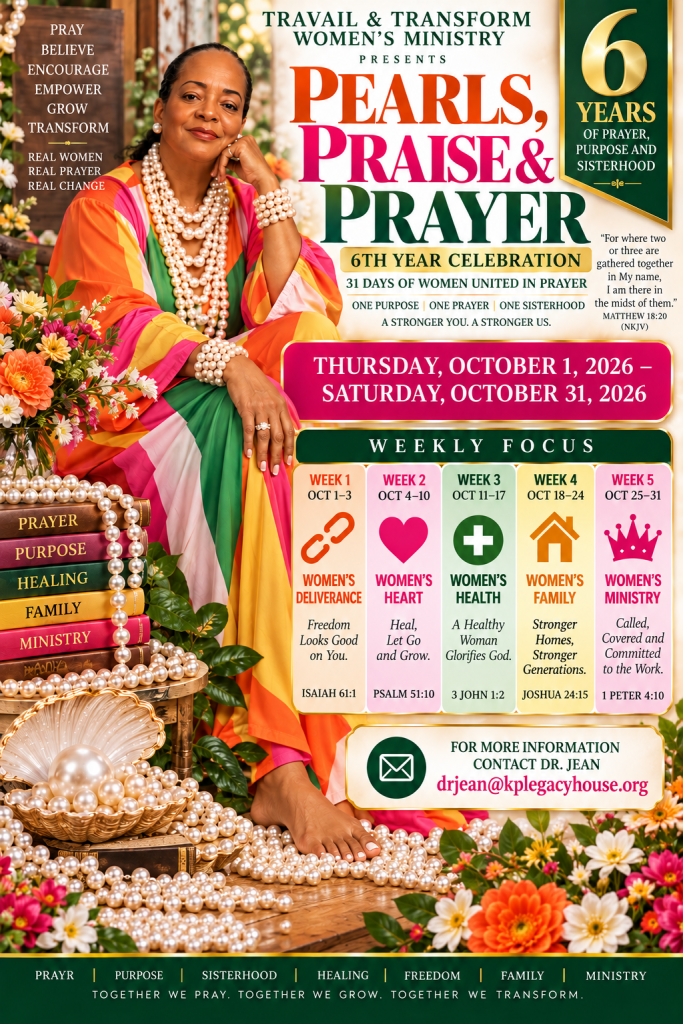
Ladies, you are invited you to join us for 31 Days of Pearls, Praise & Prayer in October!
For all 31 days of October, we will wear our pearls as a reminder to pause, praise God, and spend intentional time in prayer. Your pearls can be a necklace, bracelet, earrings, or ring. They do not have to be expensive or elaborate. The power is not in the pearls; it is just a sign that we are in unity, as our faith is in the Lord.
Each morning, put on your pearls, give God praise, and pray with us using the weekly prayer focus. Whenever you notice your pearls throughout the day, let them remind you to whisper a prayer. Before going to bed, take a moment to thank God for His faithfulness.
Our October Prayer Focus
Week
Date
Theme
Week 1
October 1–3
Women’s Deliverance
Week 2
October 4–10
Women’s Heart
Week 3
October 11–17
Women’s Health
Week 4
October 18–24
Women’s Family
Week 5
October 25–31
Women’s Ministry
Ladies, put on your pearls, lift up your praise, and join us in prayer every evening throughout October at 7:10 PM Central Time!
As we begin this new devotional journey, I want us to reflect on how God has been preparing our hearts through His Word. Over the past several weeks, our teachings have taken us through a spiritual progression of confronting our flesh, surrendering our desires, and developing a deeper, more personal relationship with Him. And now, I believe God is calling us to examine something we often take for granted: the gift of time and how we are living the days He has entrusted to us.
We began with our three-part series, “Crucify the Flesh,” where we learned that surrender requires more than an emotional decision. According to Galatians 5:24 and Matthew 16:24, following Jesus requires us to deny ourselves, confront the desires that compete with the Holy Spirit, and make a daily commitment to walk in obedience. But crucifying the flesh is not simply about what we stop doing. It is about allowing God to lead us in how we live.
From there, we moved into “For I Know: From Surrender to a Personal Declaration.” Like Job, who declared, “For I know that my redeemer liveth” (Job 19:25), we were challenged to move beyond knowing about God to knowing Him personally. We learned to declare His faithfulness, not merely because someone told us He is faithful, but because we have experienced His sustaining power in our own lives. But now I want to ask you something. What happens when the God you know does not move according to the plans you have made? What happens when you know His character but do not know His calendar? Can you still trust Him when His will requires you to surrender your expectations?
This brings us to our new three-week devotional journey, “The Gift of Today, His Will, My Stewardship, His Breath.” During our first week, “If It Is the Lord’s Will,” we will examine what it means to surrender tomorrow and live within the confines of the day God has given us, according to James 4:13–17. During our second week, “The Unfinished Business of Today,” we will examine what we have been postponing and how we are stewarding our opportunities and responsibilities, remembering the instruction in Ephesians 5:15–16 to redeem the time. Finally, in our third week, “The Space Between the Breaths,” we will reflect upon Acts 17:28 and learn to recognize God’s Presence in the ordinary moments of our lives, remembering that in Him we live, move, and have our being.
But before we can examine our unfinished business or appreciate the breath in our bodies, we must first address our relationship with time and surrender. James 4:13–17 reminds us that we can make plans, establish timelines, and anticipate outcomes without acknowledging the One who holds our tomorrow. James describes our lives as a vapor that appears briefly and then vanishes. His message is not that we should stop planning, but that we should stop living as though tomorrow belongs to us.
And I do not want us to receive this truth with fear, but with wisdom. Life being brief does not make it insignificant; it makes every moment precious. We cannot relive yesterday, and we cannot live tomorrow ahead of time. Yet how often do we spend today carrying yesterday’s disappointments or worrying about tomorrow’s uncertainties? We become so focused on where God is taking us that we overlook where He is meeting us right now. That is why this prayer will guide our first week, “Father, teach me how to live within the confines of my day, that I may flow in Your Presence in my present, and not in tomorrow nor my past, in the Name of Jesus Christ.”
And here is where everything we have been studying comes together. “For I Know” is my declaration of confidence in God, but “If the Lord Wills” is my declaration of submission to God. I know He is faithful, so I can trust Him with tomorrow. I know He is sovereign, so I can surrender my plans. I know He is present, so I can live faithfully in today without being consumed by what has not yet happened. And I want you to carry this truth in your heart, knowing God does not mean knowing everything He is going to do. Spiritual maturity is learning to trust His character while surrendering to His will. One journey. Three connected teachings. One central purpose: to surrender tomorrow, steward today, and recognize God in every breath.
Let’s Begin Day One: If It Is The Lord’s Will, The Maturity Of Surrender!
James 4:13–17 (NIV) ~ 13Now listen, you who say, “Today or tomorrow we will go to this or that city, spend a year there, carry on business and make money.” 14Why, you do not even know what will happen tomorrow. What is your life? You are a mist that appears for a little while and then vanishes. 15 Instead, you ought to say, “If it is the Lord’s will, we will live and do this or that.” 16As it is, you boast in your arrogant schemes. All such boasting is evil. 17If anyone, then, knows the good they ought to do and doesn’t do it, it is sin for them.”
Have you ever stopped to consider how much of your life is already planned before you even open your eyes in the morning? Perhaps your alarm goes off, and before your feet touch the floor, your mind is already moving through everything you need to accomplish. You begin thinking about the appointments on your calendar, the responsibilities waiting at work, the people who need something from you, the bills that must be paid, the conversations you need to have, and the assignments that still require your attention. Before you have fully entered the day, you are mentally living several hours ahead of where you actually are.
And if you are not careful, you can become so occupied with what you intend to do that you forget to acknowledge the One who has allowed you to wake up and do anything at all. This is where James 4:13–17 meets you. To understand the weight of this passage, you must first understand what James was addressing. The book of James was written to believers who needed practical instruction concerning how genuine faith should influence their everyday conduct. Throughout the letter, James challenges believers to examine the relationship between what they profess and how they actually live. He addresses trials, wisdom, speech, favoritism, pride, worldliness, and the responsibility of putting faith into action. James is not content with a faith that sounds convincing but produces little evidence of transformation.
In James chapter 4, the discussion centers on desires, conflicts, pride, humility, and submission to God. Earlier in the chapter, James declares in verse 7, “Submit yourselves therefore to God. Resist the devil, and he will flee from you.” Then in verse 10, he instructs believers to humble themselves in the sight of the Lord. By the time you arrive at verses 13–17, James applies that same principle of humility to something you may not immediately recognize as a spiritual issue: the way you make plans for your life.
James presents the example of merchants who confidently announce that they will travel to a particular city, remain there for a year, conduct business, and make a profit. Their plans appear reasonable. They have considered their destination, established their timeline, identified their activities, and anticipated their financial success. There is nothing in the passage suggesting that traveling, conducting business, or earning a profit is inherently wrong. The problem is the attitude of self-sufficiency reflected in their certainty, they speak as though they control the future.
And before you distance yourself from these merchants, consider how easily you can find yourself doing the same thing. You may not be planning to travel to another city to buy and sell merchandise, but perhaps you have already determined how your next season should unfold. You have decided when a particular door should open, how a relationship should develop, what your financial situation should look like, when your ministry should expand, or how quickly a difficult circumstance should change. You may have prayed about those things, but somewhere along the way, your expectations may have become so fixed that any interruption feels like something has gone wrong.
What happens when the appointment is canceled, the opportunity is delayed, the answer is different from what you expected, or the path you carefully planned suddenly changes? Do you immediately become frustrated, fearful, or discouraged? Do you begin questioning God’s faithfulness because the outcome does not resemble what you imagined? James is inviting you to examine whether you have placed your confidence in God or in the certainty of your plans. Proverbs 16:9 reminds you, “A man’s heart deviseth his way: but the LORD directeth his steps.” This scripture does not condemn your ability to think, prepare, or make decisions. Instead, it establishes the proper relationship between your planning and God’s direction. You may devise the way, but you must remain willing for the Lord to direct your steps. Proverbs 19:21 reinforces this truth by declaring, “There are many devices in a man’s heart; nevertheless the counsel of the LORD, that shall stand.”
You can have a plan without making your plan an idol. You can establish goals without becoming controlled by the outcome. You can prepare for tomorrow without presuming that tomorrow belongs to you. Spiritual maturity is demonstrated when you can make responsible plans while remaining humble enough to acknowledge that God’s wisdom exceeds your understanding.
In our previous devotional series, “For I Know, From Surrender to a Personal Declaration,” you were challenged to move beyond knowing about God into developing a personal conviction concerning who He is. You stood with Job and declared, “For I know that my redeemer liveth” (Job 19:25). That declaration was especially powerful because Job spoke from a place of suffering and uncertainty. His circumstances had not provided him with all the answers, but his confidence in his Redeemer remained. Now consider what happens when that confidence is tested through surrender.
You may know that God is faithful, but can you trust His faithfulness when His timing differs from yours? You may know that God is your provider, but can you remain at peace when you do not know how a particular need will be met? You may know that God orders your steps, but can you follow when His direction leads you away from something you had already decided you wanted? These questions reveal the difference between declaring your confidence in God’s character and submitting your expectations to God’s authority.
You may have learned to crucify the flesh through daily self-denial, as Jesus teaches in Matthew 16:24. You may have confronted attitudes, desires, and patterns that once controlled your decisions. Yet surrender must reach beyond the things you recognize as sinful. Sometimes what must be surrendered is your insistence on controlling something that is not inherently wrong. Your desire may be good. Your goal may be honorable. Your plan may be carefully considered. But even a good plan must remain subject to God’s will.
Think about Jesus in the Garden of Gethsemane. In Luke 22:42, He prayed, “Father, if thou be willing, remove this cup from me: nevertheless not my will, but thine, be done.” Jesus did not conceal the weight of what was before Him. He expressed His desire to the Father while submitting Himself to the Father’s will. His prayer demonstrates that surrender does not require you to pretend you have no feelings, concerns, or desires. Rather, surrender requires you to place those desires beneath the authority of God. You can tell God what you want while remaining willing to accept His direction. You can pray specifically while acknowledging that His wisdom is greater than your perspective. You can experience disappointment without allowing disappointment to become rebellion. The maturity of surrender is revealed when your trust in God remains steady even when the answer is not the one you hoped to receive.
Your Life Is a Vapor: The Humbling Reality of Time! James 4:14 asks a question that deserves more than a passing thought: “For what is your life?” Then James answers, “It is even a vapour, that appeareth for a little time, and then vanisheth away.” The word picture is simple, but its meaning is profound. James compares your earthly life to something temporary, something that appears for a little while and then disappears. Think about the mist that settles over the ground in the early morning. You may see it hovering over the grass, resting among the trees, or stretching across a field. It can appear substantial enough to obscure what lies beyond it, yet as the temperature and conditions change, the mist begins to lift. Before long, the landscape is clear, and what was visible moments earlier has vanished.
You cannot hold that mist in your hands. You cannot command it to remain. You cannot determine the precise moment it will disappear. James uses this image to confront the illusion that you possess unlimited time. Perhaps you have experienced a day when an unexpected phone call changed everything. You began the morning with an ordinary schedule, expecting to complete familiar responsibilities, only to discover that circumstances had changed in ways you never anticipated. Suddenly, the things that seemed urgent only moments earlier became less important. Your priorities shifted, and you were reminded that life can change without consulting your calendar.
Experiences like these often reveal how much of life you take for granted. You may assume there will always be another opportunity to make the phone call, express appreciation, reconcile a relationship, spend time with someone you love, or respond to something God has placed upon your heart. You tell yourself that you will do it when things slow down, when the timing improves, or when you have fewer responsibilities. But James reminds you that tomorrow has not been guaranteed.
This truth is not intended to make you live in fear of death or uncertainty. It is intended to teach you how to value the life you have been given. Psalm 90:12 says, “So teach us to number our days, that we may apply our hearts unto wisdom.” Numbering your days is not simply counting how many days you have lived. It is recognizing that your time is limited and asking God for wisdom to live meaningfully within that limitation.
When you begin to understand the brevity of life, you may discover that some things you have been worrying about do not deserve the amount of time and energy you have given them. You may recognize that certain arguments are not worth prolonging, that some offenses need to be released, and that some relationships deserve more intentional attention. You may also begin to understand that rest, gratitude, prayer, and quiet moments with God are not interruptions to a productive life, but they are an important part of a life lived with wisdom. Your life being brief does not make it insignificant, it makes the moments within it precious.
Now consider how often you attempt to live yesterday, today, and tomorrow at the same time. Your body is present in today, but your thoughts may be occupied with something that happened yesterday. You replay a conversation, reconsider a decision, or revisit a disappointment. You wonder what you should have said, what you could have done differently, or why something happened the way it did. Although the event has passed, you continue giving it space in your present. Then, almost without noticing, your thoughts move into tomorrow. You begin imagining what might happen, preparing responses to conversations that have not occurred, and worrying about problems that may never develop. You attempt to calculate every possibility because uncertainty makes you uncomfortable.
And while your attention moves between what has already happened and what has not yet happened, the moments available to you today continue passing. This is why the words of Jesus in Matthew 6:34 are so important: “Take therefore no thought for the morrow: for the morrow shall take thought for the things of itself. Sufficient unto the day is the evil thereof.” In the broader context of Matthew 6:25–34, Jesus is teaching His followers not to be consumed with anxiety about life’s necessities. He points to the birds of the air and the lilies of the field as reminders of the Father’s care. He is not encouraging irresponsibility or suggesting that practical preparation is unnecessary. He is teaching you that anxiety should not become the governing force of your life.
Jesus directs you to seek first the kingdom of God and His righteousness, trusting that your heavenly Father knows your needs. Then He reminds you that each day has enough concerns of its own. You are not required to carry the emotional weight of every possible tomorrow while fulfilling today’s responsibilities. You can prepare without becoming consumed. You can remember without remaining imprisoned. You can acknowledge uncertainty without surrendering your peace to it. This is where your prayer becomes deeply personal, “Father, teach me how to live within the confines of my day, that I may flow in Your Presence in my present, and not in tomorrow nor my past, in the Name of Jesus Christ.”
Living within the confines of your day means recognizing the responsibilities, opportunities, and limitations of the day God has placed before you. It means learning to distinguish between what requires your attention now and what must be entrusted to Him. It means accepting that you cannot accomplish everything at once, resolve every uncertainty immediately, or control every circumstance. It also means recognizing that God’s Presence is not reserved for a future season when everything finally comes together. He is available to you in the ordinary moments of the day you are living right now.
You can acknowledge Him while preparing breakfast, driving to work, caring for your family, completing an assignment, sitting quietly, or making an important decision. You do not have to wait until your circumstances become extraordinary to recognize His Presence. You may be so focused on asking God what He will do next that you overlook what He is teaching you now. You may be praying for the next opportunity while failing to recognize the responsibility already in your hands. You may be asking for greater things while neglecting to give thanks for the ordinary provisions that sustain your life.
The invitation is to become attentive to God where you are, rather than continually postponing your awareness of Him until you arrive somewhere else. James 4:15 provides the correction to the attitude he has been addressing: “For that ye ought to say, If the Lord will, we shall live, and do this, or that.” Notice that James does not instruct you to abandon your plans. He instructs you to acknowledge the Lord’s will within them. The problem is not that you have a calendar, a vision, or a goal. The problem arises when you begin treating those things as though they are guaranteed and entirely within your control.
Consider how differently you might approach your day if you sincerely acknowledged God’s authority over it. You would still prepare for your responsibilities, but you would remain willing to adjust when necessary. You would still pursue meaningful goals, but you would not allow those goals to determine your identity or your peace. You would still pray for desired outcomes, but you would trust God’s wisdom when circumstances unfolded differently.
Saying “If the Lord wills” must become more than a religious expression added to the end of your sentences. It must become a genuine posture of humility. You can say those words with your mouth while still resisting God’s direction in your heart. You can speak about surrender while remaining unwilling to release your expectations. James is calling you beyond the language of submission into the practice of submission. This is why James 4:16 confronts boasting and arrogance. The merchants were not merely making plans; they were expressing confidence in their ability to determine the future. James exposes the pride beneath that assumption.
Pride is not always loud or obvious. Sometimes it appears in your unwillingness to accept limitations. Sometimes it appears when you believe everything depends upon your ability to make things happen. Sometimes it appears when you become frustrated because you cannot control another person’s decisions, the timing of an opportunity, or the outcome of a situation. Humility allows you to recognize that you are responsible for your obedience, but you are not sovereign over the results. Romans 12:1–2 teaches you to present yourself as a living sacrifice and to be transformed through the renewing of your mind. That transformation includes the way you think about your plans, your responsibilities, and your future. As your mind is renewed by God’s Word, you learn to approach life with greater dependence upon Him. You begin to understand that surrender does not make you passive. It makes you responsive to God’s direction.
James concludes this passage with a statement that connects surrender to responsibility. In James 4:17, he writes, “Therefore to him that knoweth to do good, and doeth it not, to him it is sin.” This verse reminds you that acknowledging the uncertainty of tomorrow does not excuse neglecting what you know is right today. You cannot control the future, but you remain accountable for how you respond to the responsibilities and opportunities God has entrusted to you. Perhaps there is someone you need to encourage, an apology you need to offer, a responsibility you need to address, or an act of kindness you have continually postponed. Perhaps you have been waiting for circumstances to become perfect before taking a step you already know is appropriate.
James challenges you to examine whether your delay is rooted in wisdom or avoidance. At the same time, you must remember that faithfulness does not mean attempting to complete every possible task in a single day. You are human, and your limitations are real. Some things require preparation, healing, counsel, or the cooperation of others. Living faithfully today means responding wisely to what is genuinely within your responsibility, not placing an impossible burden upon yourself. The truth is that you do not have to control tomorrow to be faithful today.
You can love the people around you today. You can speak with kindness today. You can fulfill your responsibilities today. You can pray today. You can practice forgiveness today. You can give thanks today. You can respond to God’s Word today. And when the day ends, you can entrust what remains unfinished to the Lord, knowing that your value is not measured by how much you managed to accomplish. As you reflect on this first devotional, consider what your life might look like if you truly allowed what you know about God to govern how you approach what you do not know about tomorrow. Perhaps you would worry less and pray more. Perhaps you would hold your expectations more loosely and your faith more firmly. Perhaps you would become more attentive to the people and moments you have been overlooking.
Most importantly, perhaps you would begin to recognize that spiritual maturity is not demonstrated by your ability to predict what comes next, but by your willingness to remain faithful to God in the present. You have learned to declare, “For I know that my Redeemer lives.” Now you are being challenged to demonstrate that confidence through the words, “If it is the Lord’s will, I shall live and do this or that.” You can be confident in God’s character without being certain of His calendar. You can trust His faithfulness without knowing every detail of His plan. And you can surrender tomorrow without neglecting the responsibilities of today. As you move forward, allow this truth to settle within your heart, what you know about God should give you the confidence to surrender what you do not know to God.
As you prepare to pray, examine the way you have been approaching your plans and expectations. Consider whether you have truly invited God to direct your steps or whether you have simply asked Him to approve decisions you have already made. Think about the areas of your life where uncertainty has produced anxiety, where disappointment has produced resistance, or where your desire for control has made surrender difficult. Ask yourself whether you are fully present in the day God has given you or whether your attention has been divided between yesterday’s experiences and tomorrow’s possibilities. Most importantly, consider this question, If you genuinely believe that God is faithful, sovereign, and wise, what are you still afraid to place in His hands?
Let’s Pray:
Father, in the mighty and matchless Name of Jesus Christ, I come before You with a grateful heart, acknowledging that You are God and that there is none like You. You are eternal, sovereign, faithful, merciful, and wise. You know the beginning from the end, and nothing concerning my life is hidden from Your sight. Thank You for allowing me to awaken to another day, for the breath in my body, for the strength You have provided, and for the opportunity to come before Your throne of Grace. Father, as I reflect upon Your Word in James 4:13–17, I recognize how easily I can become consumed with my plans, responsibilities, and expectations. I acknowledge that there have been times when I have spoken about tomorrow as though it belonged to me. I have made decisions, established timelines, and imagined outcomes without always stopping to seek Your wisdom or submit my desires to Your authority. Forgive me for the pride that sometimes hides beneath my planning and for the self-sufficiency that causes me to depend more upon my understanding than upon Your direction. Lord, I have declared that I know You. I know that You are faithful, that You are my Redeemer, and that You have sustained me through circumstances I could not have overcome in my own strength. Yet I confess that there are moments when I still struggle to surrender the things I cannot control. I believe in Your power, but sometimes I become impatient with Your timing. I trust Your wisdom, but sometimes I resist when Your direction differs from my desires. Father, continue the work of transformation within me so that my confidence in Your character produces genuine submission to Your will. Teach me to crucify the desires of my flesh that compete with Your leading. Where pride has taken root, cultivate humility. Where impatience has influenced my decisions, develop endurance. Where fear has caused me to grasp for control, strengthen my faith. Where disappointment has hardened my heart, restore tenderness and trust. Help me recognize that surrender is not merely something I declare during prayer but a posture I must practice in my everyday life. Father, Your Word reminds me that my life is like a vapor, appearing for a little while and then vanishing away. Teach me to number my days and apply my heart unto wisdom. Help me recognize the preciousness of every moment You have entrusted to me. Forgive me for the times I have taken ordinary blessings for granted, overlooked opportunities to express love, postponed necessary acts of kindness, or allowed unnecessary concerns to consume my attention. Lord, teach me how to live within the confines of my day, that I may flow in Your Presence in my present, and not in tomorrow nor my past, in the mighty Name of Jesus Christ. When my thoughts begin to travel backward into yesterday’s disappointments, remind me of Your mercy and the lessons You have allowed me to learn. When my mind begins to race ahead into tomorrow’s uncertainties, remind me that You are already aware of every circumstance I will face. Help me remain grounded in the truth of Your Word and attentive to the responsibilities and opportunities before me today. Father, I bring before You the things I have been trying to control. I surrender the plans that have become greater than my peace, the expectations that have become difficult to release, and the outcomes I have been attempting to determine through my own strength. I surrender my family, my relationships, my work, my ministry, my finances, my responsibilities, and the concerns I have carried silently within my heart. Give me wisdom to make responsible decisions while remaining willing to follow Your direction. Teach me the difference between preparation and presumption, between faithful responsibility and unnecessary worry, and between remembering yesterday and remaining captive to it. Help me recognize when I need to act, when I need to wait, when I need to seek wise counsel, and when I need to release something that does not belong within my control. May I never confuse surrender with inactivity, nor mistake constant activity for obedience. Father, give me today’s bread for today’s needs. Give me today’s wisdom for today’s decisions, today’s strength for today’s responsibilities, today’s patience for today’s challenges, and today’s grace for today’s journey. When unexpected circumstances interrupt my schedule, Father, help me respond with wisdom rather than frustration. When doors do not open according to my expectations, help me remain faithful rather than bitter. When answers are delayed, strengthen my trust rather than allowing fear to govern my thoughts. Lord, make me more aware of Your Presence in the ordinary moments of my life. Help me recognize You while I am working, serving, caring for others, resting, making decisions, and fulfilling the assignments You have entrusted to me. Do not allow me to become so consumed with seeking the next opportunity that I overlook the blessings and responsibilities already before me. Teach me to appreciate the people You have placed in my life and to demonstrate love, compassion, patience, and kindness while I have the opportunity. And Father, where I know to do good, give me the willingness to respond. Where reconciliation is appropriate and possible, guide me in wisdom and humility. Where forgiveness is needed, work within my heart. Where responsibilities have been neglected, give me the discipline to address them. Where I have been postponing what You have clearly instructed me to do, help me move forward in faithful obedience. Above all, Father, teach me to trust You with the things I cannot see. I may not know what tomorrow will bring, but I know that You are faithful. I may not understand every change in my circumstances, but I know that Your wisdom exceeds mine. I may not have every answer, but I know that I can come before You in prayer and receive grace to help me in my time of need. As I continue this devotional journey, let the words “If it is the Lord’s will” become more than a familiar expression. Let them become the sincere declaration of a heart that is fully surrendered to You. May my plans remain submitted, my faith remain steadfast, and my life reflect the humility of one who recognizes that every day is a gift from Your hand. And until tomorrow becomes today, Father, keep me present with You. Help me live wisely, love intentionally, serve faithfully, and rest securely in Your care. I surrender my will to Your will, my timing to Your timing, and my expectations to Your wisdom, trusting that You are worthy of my complete dependence. In the mighty and matchless Name of Jesus Christ, I pray. Amen and Amen!
Nugget ~ “For I Know” establishes your confidence in God; “If the Lord Wills” reveals your willingness to surrender to Him. Do not allow yesterday to rob you of today’s Presence or tomorrow to borrow today’s grace. What you know about God should give you the confidence to trust Him with what you do not know.
Blessings…
Love, Dr. Jean…
Ladies, you are invited you to join us for 31 Days of Pearls, Praise & Prayer in October!
For all 31 days of October, we will wear our pearls as a reminder to pause, praise God, and spend intentional time in prayer. Your pearls can be a necklace, bracelet, earrings, or ring. They do not have to be expensive or elaborate. The power is not in the pearls; it is just a sign that we are in unity, as our faith is in the Lord.
Each morning, put on your pearls, give God praise, and pray with us using the weekly prayer focus. Whenever you notice your pearls throughout the day, let them remind you to whisper a prayer. Before going to bed, take a moment to thank God for His faithfulness.
Our October Prayer Focus
Week
Date
Theme
Week 1
October 1–3
Women’s Deliverance
Week 2
October 4–10
Women’s Heart
Week 3
October 11–17
Women’s Health
Week 4
October 18–24
Women’s Family
Week 5
October 25–31
Women’s Ministry
Ladies, put on your pearls, lift up your praise, and join us in prayer every evening throughout October at 7:10 PM Central Time!
Galatians 5:24–25 (NKJV) “And those who are Christ’s have crucified the flesh with its passions and desires. If we live in the Spirit, let us also walk in the Spirit.”
Hebrews 5:14 (NKJV) “But solid food belongs to those who are of full age, that is, those who by reason of use have their senses exercised to discern both good and evil.”
Psalm 19:14 (NKJV) “Let the words of my mouth and the meditation of my heart Be acceptable in Your sight, O LORD, my strength and my Redeemer.”
What You Know Must Become How You Live! Job declared that his Redeemer lived while he was still surrounded by suffering and unanswered questions. His declaration was not based on a sudden change in his circumstances. He spoke from his confidence in the One he knew. In Galatians 5, Paul teaches believers that the desires of the flesh and the leading of the Spirit pull in different directions. He calls them to walk in the Spirit rather than surrender control to every impulse. Crucifying the flesh is not a one-time statement that removes every future struggle. It is a commitment to stop allowing sinful desires to rule and to keep choosing a Spirit-led life.
Hebrews 5 addresses believers who should have been growing in their understanding but still needed to be taught the basics. The writer compares spiritual immaturity to needing milk and maturity to being ready for solid food. Verse 14 emphasizes that discernment develops “by reason of use.” Growth requires practice.
And in Psalm 19:14, David asks God to examine both his words and his inner thoughts. His prayer reminds us that our relationship with God must reach beyond what we declare publicly and into what we allow to guide us privately. These Scriptures bring our journey together: You can know that your Redeemer lives, but you must also choose, day by day, to live under His direction.
We have reached the final day of For I Know, but before you close this devotional and move on to the next thing, I want you to think about where this journey began. You were challenged to crucify your flesh, to stop allowing every desire, reaction, and familiar habit to determine your choices. Then you asked, “Who’s leading me?” You considered whether you were truly following the Holy Spirit or simply asking God to approve the direction you had already chosen.
And now you have spent this week declaring, “For I know that my Redeemer lives.” What a powerful declaration! But here is the question you must carry beyond this series: Will the God you say you know be reflected in the life you choose to live today? It is possible to finish a devotional, feel encouraged, and still return to an old response before the day is over. Someone says something that frustrates you, and suddenly you want to give them a piece of your mind. An opportunity presents itself, and you want to say yes before asking whether it is wise. A difficult responsibility comes along, and you want to avoid it because you would rather remain comfortable.
That is why Galatians 5:25 says, “If we live in the Spirit, let us also walk in the Spirit.” Walking is something you continue doing. You cannot rely on yesterday’s decision to make today’s choices for you. You must remember every day to put your flesh under subjection. When an old attitude rises, you do not have to give it the final word. When your feelings are strong, you can acknowledge them without allowing them to govern your behavior. When you recognize a temptation to return to what God has been teaching you to leave behind, you can pause, pray, and choose a different response. Paul writes in 1 Corinthians 9:27, “But I discipline my body and bring it into subjection.” He describes intentional discipline, not a life in which self-control happens automatically. And Romans 8:13 teaches that it is by the Spirit that believers put to death the deeds of the body. You are not being called to prove how strong you are on your own. You are being called to keep yielding to the Holy Spirit as you practice obedience.
Crucifying the flesh is not a declaration you make once and then forget. It is a daily refusal to let the old you take the lead, and while you are learning to make those daily choices, you must also be willing to grow up. Hebrews 5:12–14 challenges believers who had remained dependent on spiritual milk when they should have been ready for solid food. The writer does not say that maturity comes simply because enough years have passed. He says that mature believers have exercised their discernment through use. Think about that. You can hear a lesson about patience and still need to practice patience. You can study forgiveness and still need to work through the difficult process of forgiving. You can learn about discernment and still need to slow down long enough to examine what is before you. And you need to know that you will not be a baby forever, and you cannot keep expecting to be carried through lessons God is teaching you to walk out.
First Corinthians 13:11 says, “When I became a man, I put away childish things.” There comes a time when you must stop excusing a harmful response by saying, “That is just how I am.” There comes a time when you must stop avoiding a necessary conversation because it makes you uncomfortable. There comes a time when you must take responsibility for what you have learned and begin putting it into practice. Growth does not mean you will never need help again. It means you are becoming more willing to receive corrections, seek wisdom, and act on the truth you already know. As James 1:22 reminds us, “But be doers of the word, and not hearers only.” Now, do not confuse growing up with having everything figured out. Even as you mature, you will encounter situations that require you to ask God for wisdom. James 1:5 encourages you to ask Him when you lack it. Spiritual maturity does not eliminate dependence on God; it teaches you to depend on Him more deliberately. And when the road becomes difficult, return to the declaration that has carried us through this series: “For I know that my Redeemer lives” (Job 19:25).
Job did not have every answer when he said those words. Neither will you. There will be days when you have to make a decision without knowing how every detail will unfold. There will be seasons when you must remain faithful while waiting for clarity. There will be moments when you recognize that you have fallen short and need to repent, make things right, and begin again. In those moments, remember that your Redeemer lives. Because He lives, (you can face whatever it is) you can bring your need before Him instead of trying to carry it alone. Because He lives, you can seek forgiveness rather than hide behind shame. Because He lives, you can continue growing instead of deciding that an old habit must always define you.
Philippians 1:6 reminds believers that God, who began a good work in them, will bring it to completion. You are still growing, Sunshine, but you must participate in that growth. Keep showing up in prayer. Keep opening His Word. Keep practicing discernment. Keep making the next faithful choice. And remember David’s prayer in Psalm 19:14: “Let the words of my mouth and the meditation of my heart be acceptable in Your sight.” Before your words reach someone else, before your thoughts become actions, invite God to examine what is happening within you. You have learned that you belong to your Creator, that you are called to honor your King, follow your Shepherd, remain willing to be shaped by your Potter, and place your hope in your Redeemer. Those are not merely names to remember during a devotional. They describe the relationship you are called to live in when the devotional is over.
So, tomorrow morning, when you wake up and there is no new day of this series waiting for you, the journey does not end. You still have a choice to make. Will you let your flesh lead, or will you walk in the Spirit? Will you remain comfortable with what you already know, or will you put it into practice and grow? Will you allow the uncertainty of your circumstances to silence your faith, or will you remember that your Redeemer lives? Sunshine, you have crucified your flesh so you can’t respond the same way as before. You have examined who is leading you. You have declared what you know. Now keep living like you know Him. As you finish this series, I want you to consider these three questions: What old response must you continue bringing under the Holy Spirit’s direction? What truth have you learned that you now need to practice consistently? And when life becomes uncertain, what will help you remember that your Redeemer lives? So, choose one practical action for today. It may be pausing before a difficult response, taking responsibility for something you have avoided, or beginning your morning in prayer before allowing the demands of the day to direct your thoughts.
Let’s Pray:
Heavenly Father, thank You for carrying me through this journey of surrender, spiritual growth, and personal faith. Thank You for every Scripture that has challenged me, every truth that has encouraged me, and every area of my life You have invited me to examine. I do not want to finish this series and leave behind what You have been teaching me. Help me carry these lessons into the way I live each day. Lord, I acknowledge that crucifying my flesh is not a decision I can make once and never think about again. There are old habits, attitudes, and reactions that may try to rise when I am tired, frustrated, disappointed, or afraid. When they do, help me recognize them before I act. Give me the humility to pause, the courage to choose differently, and the self-control to refuse what would pull me away from Your direction. Holy Spirit, lead me in the ordinary moments when my choices reveal what is truly guiding me. When I am tempted to speak out of anger, help me respond with wisdom. When I want to rush into a decision, teach me to slow down and seek Your guidance. When I am tempted to avoid a responsibility or excuse a familiar behavior, remind me that I am called to keep growing. Father, I do not want to remain spiritually immature because I am unwilling to practice what I have learned. Help me move beyond hearing Your Word to living it. Teach me to receive correction without becoming defensive, to acknowledge my mistakes without making excuses, and to seek forgiveness when I have caused harm. Give me a teachable heart and the perseverance to practice discernment even when doing so requires patience and effort. Lord, thank You that growing up in my faith does not mean I must pretend to have every answer. Remind me that I can ask You for wisdom, seek sound counsel, and admit when I need help. Keep me from confusing independence with maturity. Teach me to become more responsible in my choices while remaining dependent on You. When difficult days come, bring Job’s declaration back to my heart: “For I know that my Redeemer lives.” When I do not understand why something has happened, remind me of who You are. When I do not know when a situation will change, help me remain faithful with what is before me. When I make a mistake, lead me toward repentance and the next right step rather than allowing shame to keep me from You. Father, let the words of my mouth and the meditation of my heart be acceptable in Your sight. Search the thoughts I entertain, the motives behind my decisions, and the words I am preparing to speak. Let my private choices agree with my public declaration. May my life testify to the One I say I know. Thank You for being my Creator, my King, my Shepherd, my Potter, and my Redeemer. Continue shaping me into a person who reflects Your love, truth, and grace. Let this not be the end of a lesson but the beginning of a deeper commitment to live what I have learned. Today and every day You give me breath, help me remember I must put my flesh under subjection, I must continue growing, and I must never forget that my Redeemer lives. In the Mighty Name of Jesus Christ, my Lord and Savior, Amen.
Nugget: You cannot live today on yesterday’s surrender. Put your flesh under subjection, practice what you have learned, and keep growing. You were not meant to remain a spiritual baby forever. And through every season of growth, hold fast to this declaration: “For I know that my Redeemer lives.”
I want you to remember this every day:
This series may be ending, but your daily walk with God continues. You do not graduate from needing the Holy Spirit, and you do not outgrow the need to examine your heart. Each morning is another opportunity to choose who will lead you and whether you will live out what you know.
Carry these three declarations with you:
1. I will put my flesh under subjection. My feelings are real, but they do not have to make my decisions. With the Holy Spirit’s help, I can pause, exercise self-control, and choose obedience.
2. I will grow up and keep growing. I will not use what I have always done as an excuse for what I refuse to change. I will receive correction, exercise discernment, and put God’s Word into practice. I will not remain a spiritual baby forever.
3. I will remember that my Redeemer lives. I may not know every why, when, or how, but I know the One to whom I belong. When I need wisdom, I will seek Him. When I fall short, I will return to Him. When the road is uncertain, I will keep walking with Him.
Sunshine, crucify what tries to control you. Grow beyond what once kept you immature. And never let a difficult day make you forget the declaration that grounds your faith: FOR I KNOW THAT MY REDEEMER LIVES!
Blessings…
Love, Dr. Jean…
Have A Great Weekend…
Ladies, you are invited you to join us for 31 Days of Pearls, Praise & Prayer in October!
For all 31 days of October, we will wear our pearls as a reminder to pause, praise God, and spend intentional time in prayer. Your pearls can be a necklace, bracelet, earrings, or ring. They do not have to be expensive or elaborate. The power is not in the pearls; it is just a sign that we are in unity, as our faith is in the Lord.
Each morning, put on your pearls, give God praise, and pray with us using the weekly prayer focus. Whenever you notice your pearls throughout the day, let them remind you to whisper a prayer. Before going to bed, take a moment to thank God for His faithfulness.
Our October Prayer Focus
Week
Date
Theme
Week 1
October 1–3
Women’s Deliverance
Week 2
October 4–10
Women’s Heart
Week 3
October 11–17
Women’s Health
Week 4
October 18–24
Women’s Family
Week 5
October 25–31
Women’s Ministry
Ladies, put on your pearls, lift up your praise, and join us in prayer every evening throughout October at 7:10 PM Central Time!
Job 19:25 (NKJV) “For I know that my Redeemer lives, And He shall stand at last on the earth.”
Psalm 100:3 (NKJV) “Know that the LORD, He is God; It is He who has made us, and not we ourselves; We are His people and the sheep of His pasture.”
Isaiah 64:8 (NKJV) “But now, O LORD, You are our Father; We are the clay, and You our potter; And all we are the work of Your hand.”
Knowing God Changes How You See Yourself! In Job 19, Job declares that his Redeemer lives while he is still enduring suffering and uncertainty. His confidence is not rooted in having every answer. It is rooted in the One he knows. Psalm 100 calls God’s people to acknowledge Him as their Creator and Shepherd. Verse 3 reminds them that He made them, that they belong to Him, and that they are the sheep of His pasture. Knowing who God is changes how they understand themselves: they are not without a Shepherd, and they do not have to depend entirely on their own strength.
In Isaiah 64, the people cry out to God in a time of distress. They call Him their Father and Potter and describe themselves as clay in His hands. Their words acknowledge both their need for His mercy and His continuing authority over their lives. Together, these passages invite us to move beyond simply naming God’s attributes. If He is our Creator, our lives belong to Him. If He is our Shepherd, we need His guidance. If He is our Potter, we must remain willing to be shaped. And if He is our Redeemer, our hope rests in Him. Knowing who God is should change how you see yourself, how you approach Him, and how you live.
Imagine receiving an invitation to an important gathering. You read the date, time, and location, but before putting it away, you notice something that makes you smile: your name is written on it. You do not have to stand outside wondering whether you are welcome. You do not have to borrow someone else’s invitation or convince the host that you deserve to enter. You have been invited by name. But receiving the invitation is not the same as attending the gathering. You still have to respond and walk through the door. You can know that you belong to God and still live as though you have no one to turn to, no guidance to seek, and no reason to change. Belonging is a gift, but living in that relationship calls for a response.
Think about a time when you introduced yourself to someone, and the moment they heard your name, they asked, “Are you related to so-and-so?” Suddenly, the conversation took a different turn. Your name revealed a connection to someone they knew, and that relationship changed the way they saw you. Now think about what it means to say that you belong to God. You can introduce Him as your Creator, King, Shepherd, Potter, and Redeemer. You can speak those names during prayer, hear them in a sermon, and read them throughout Scripture. But what happens when you begin allowing those names to shape how you see yourself and how you live?
It is one thing to know what God is called. It is another thing to live in the relationship those names describe. Psalm 100:3 says, “It is He who has made us, and not we ourselves; We are His people and the sheep of His pasture.” You did not create yourself, and you were never meant to sustain yourself without God. You have responsibilities, abilities, and work to complete, but your worth is not something you must manufacture through constant achievement. Ephesians 2:10 reminds us that we are God’s workmanship, created in Christ Jesus for good works. Sunshine, you have purpose, but purpose does not require you to say yes to every opportunity or carry every burden. You are His creation before you accomplish another task, receive another title, or meet another person’s expectations.
Now consider what it means to know Him as your King. A king has authority. Yet it is possible to call God your King while continuing to treat your personal preferences as though they have the final say over every decision. Jesus asks in Luke 6:46, “But why do you call Me ‘Lord, Lord,’ and not do the things which I say?” This question invites you to examine whether the authority you acknowledge with your mouth is becoming visible in your choices. Sometimes honoring God means telling the truth when dishonesty would be easier, apologizing without making excuses, or declining an opportunity that would pull you away from responsibilities you already have. Knowing Him as King means allowing His Word to have authority even when it challenges what you want.
And what about knowing Him as your Shepherd? Psalm 23:1 begins with David’s personal declaration: “The LORD is my shepherd; I shall not want.” David does not merely say that the Lord is a shepherd. He says, “The LORD is my shepherd.” Jesus says in John 10:27, “My sheep hear My voice, and I know them, and they follow Me.” Notice the relationship: He knows them, and they follow Him. You may not know what the next season will hold. You may not know how a difficult conversation will unfold or whether an opportunity will develop the way you hope. But you can seek God’s guidance through prayer and Scripture, gather the information you need, and take the next faithful step without demanding to see the entire journey first. If you know Him as your Shepherd, you do not have to know every road. You must remain willing to follow.
And then there is the Potter. Isaiah 64:8 says, “We are the clay, and You our potter; And all we are the work of Your hand.” Maybe you have recognized an old response that needs to change, a habit you have excused for years, or a conversation you keep avoiding. Perhaps you are comfortable encouraging others to grow but become defensive when someone offers you correction. Knowing God as your Potter means you can remain open to His work instead of assuming that the way you have always been is the way you must remain. Romans 12:2 calls believers to be transformed by the renewing of their minds. That transformation requires more than agreeing that change would be good. It calls for a willingness to practice a different way of living. Being unfinished does not mean you are without purpose. It means you must remain willing to be shaped. And now we return to the declaration that began this series: “For I know that my Redeemer lives” (Job 19:25).
Job spoke those words while his circumstances were still painful and uncertain. When you know God as your Redeemer, you can bring Him the parts of your story that you cannot repair through your own effort. You can acknowledge your mistakes without deciding that your mistakes are the whole of who you are. Colossians 1:13–14 speaks of God delivering believers from the power of darkness and bringing them into the kingdom of His Son, “in whom we have redemption through His blood, the forgiveness of sins.” Your hope in redemption rests in what Christ has done, not in your ability to present a flawless record. You do not have to deny what happened in your past or pretend that painful experiences had no effect on you. You can tell the truth about your story while continuing to seek healing, establish healthier boundaries, take responsibility for your choices, and trust that God’s work in you has not ended.
Your past may be part of your testimony, but it does not have to be the only thing your life testifies about. Now bring these relationships together. If He is your Creator, remember that your worth does not depend on constant achievement. If He is your King, allow His Word to influence your decisions. If He is your Shepherd, seek His guidance. If He is your Potter, remain open to growth. If He is your Redeemer, place your hope in Him as you continue walking forward. These are not five separate names to memorize and put away. They are reminders of the relationship you are called to live in each day. And that brings us back to Psalm 19:14: “Let the words of my mouth and the meditation of my heart be acceptable in Your sight, O LORD, my strength and my Redeemer.”
You can declare that God is your Shepherd and still admit that you need guidance. You can call Him your Potter and acknowledge that an area of your life needs to change. You can proclaim that your Redeemer lives while being honest about a difficult season you are still walking through. You do not have to perform perfection to belong to Him. But do not allow the comfort of belonging to become an excuse to remain unchanged. Sunshine, you have crucified it. You have examined who is leading you. You have begun declaring what you know. Now live like you know whose you are. Ask yourself which description of God do you most need to remember in your present season: Creator, King, Shepherd, Potter, or Redeemer? Consider what that relationship means and identify one way it can influence a decision, conversation, or responsibility before you today.
Let’s Pray:
Heavenly Father, thank You for reminding me that I belong to You. Thank You that I do not have to earn my place in Your care through constant achievement or perfect decisions. You are my Creator, my King, my Shepherd, my Potter, and my Redeemer. Today, help me understand what those names mean for the way I live. Lord, as my Creator, remind me that my life has value because I am made by You. Forgive me for the times I have measured my worth only by what I accomplish, how much I can carry, or how many people I can help. Teach me to use the abilities You have given me faithfully while also recognizing my limits. As my King, teach me to honor Your authority in my daily decisions. When my preferences conflict with what Your Word teaches, give me humility to examine my choices. Help me tell the truth when it is difficult, make things right when I have caused harm, and act with integrity even when nobody else is watching. As my Shepherd, guide me when the road ahead is unfamiliar. When I am uncertain, help me turn toward You in prayer rather than allowing worry to make every decision for me. Give me wisdom to seek sound counsel, consider the information before me, and take the next faithful step. When I become impatient with the journey, remind me that I do not have to know every turn in order to keep trusting You. As my Potter, continue shaping my heart and renewing my mind. Show me where I have become comfortable with a response, habit, or attitude that needs to change. When correction comes, help me receive it without becoming defensive or overwhelmed by shame. Give me the courage to practice what I am learning, even when a new response feels unfamiliar. As my Redeemer, remind me that my hope rests in Jesus Christ. Thank You for the forgiveness and new life I have through Him. Help me acknowledge my past honestly without allowing it to become the only way I understand myself. Where I need to seek forgiveness, give me humility. Where I need to make amends, give me courage. Where I need healing, wisdom, or support, help me take the steps that are before me. Father, let the words of my mouth and the meditation of my heart be acceptable in Your sight. Help me speak about myself and others with truth and grace. When I am frustrated, guide my response. When I am disappointed, help me bring my feelings honestly before You. When I am uncertain, remind me of what Your Word reveals about who You are. Holy Spirit, continue leading me beyond these devotional moments. Let what I know about God become visible in my relationships, my work, my ministry, and the decisions I make in private. Help me become a doer of Your Word, not merely someone who can repeat it. And Lord, when I forget whose I am, bring me back to this truth: I am Your creation, I belong to Your care, and You are continuing Your work in me. Let my declaration be more than words I speak. Let it become a life that reflects my relationship with You. For I know that my Redeemer lives. And because I belong to You, I want to live like it. In the Jesus Christ Name, Amen.
Nugget: Knowing God’s names is a beginning. Living in relationship with Him is the daily response. If He is your Creator, remember whose you are. If He is your King, honor His Word. If He is your Shepherd, seek His guidance. If He is your Potter, remain willing to grow. And if He is your Redeemer, keep your hope in the One who lives!
Ladies, you are invited you to join us for 31 Days of Pearls, Praise & Prayer in October!
For all 31 days of October, we will wear our pearls as a reminder to pause, praise God, and spend intentional time in prayer. Your pearls can be a necklace, bracelet, earrings, or ring. They do not have to be expensive or elaborate. The power is not in the pearls; it is just a sign that we are in unity, as our faith is in the Lord.
Each morning, put on your pearls, give God praise, and pray with us using the weekly prayer focus. Whenever you notice your pearls throughout the day, let them remind you to whisper a prayer. Before going to bed, take a moment to thank God for His faithfulness.
Our October Prayer Focus
Week
Date
Theme
Week 1
October 1–3
Women’s Deliverance
Week 2
October 4–10
Women’s Heart
Week 3
October 11–17
Women’s Health
Week 4
October 18–24
Women’s Family
Week 5
October 25–31
Women’s Ministry
Ladies, put on your pearls, lift up your praise, and join us in prayer every evening throughout October at 7:10 PM Central Time!
Psalm 19:14 (NKJV) “Let the words of my mouth and the meditation of my heart Be acceptable in Your sight, O LORD, my strength and my Redeemer.”
Here is some food for thought, creation declares it, but what does your life say about it? In Psalm 19, David begins by looking at creation. The heavens declare God’s glory, and the sky displays His handiwork. Day after day and night after night, creation bears witness to the One who made it. David describes the sun moving across the heavens and then turns his attention to something closer to home: the Word of God and the condition of his own heart. He speaks of the Lord’s law as perfect, His testimony as sure, and His commandments as right (Psalm 19:7–8). God’s Word does more than give David information about the Creator; it teaches him how to live before Him. By the end of the psalm, David is no longer speaking only about what the heavens declare. He is asking God to examine what comes out of his mouth and what takes place within his heart.
And Job’s declaration in Job 19:25 adds another dimension to this picture. Job does not proclaim that his Redeemer lives because his circumstances are easy. He declares what he knows about God while enduring suffering and uncertainty. Together, these passages invite us to consider the relationship between what we say we know about God and what our lives reveal about Him. Creation bears witness simply by being what God made it to be. Our testimony becomes visible in the way we trust Him, respond to His Word, and live before others, even when life is difficult.
Everyday I need you to think. Have you ever watched the sunrise and found yourself standing still for a moment? Perhaps the morning sky was filled with color, or the light was just beginning to reach across the ground. You did not need anyone to explain that the sun had risen. You could see its light. David looked at creation and said, “The heavens declare the glory of God” (Psalm 19:1). The heavens do not need a microphone to announce their Maker. The sun does not have to persuade anyone that it is shining. Creation bears witness to God’s handiwork by doing what He created it to do. Now, consider your own life.
You can say, “For I know that my Redeemer lives,” and those words can be a sincere declaration of faith. But what happens after you finish speaking? What does your life say when someone disappoints you, when your plans change, when you must make a difficult decision, or when you have an opportunity to do what is right even though no one else will know? Your testimony is not only the story of what God has brought you through. It is also the way you live because of what you have come to know about Him. Sometimes we think of a testimony as something we stand up and share after a difficult season has ended. We tell people where we were, what happened, how God helped us, and where we are now. Those stories matter. Revelation 12:11 speaks of overcoming “by the blood of the Lamb and by the word of their testimony.” There is value in telling others what God has done. And just so you are clear about this one thing, your testimony does not have to wait for a microphone, a church service, or a moment when you can tell the entire story from beginning to end. Your life is speaking while you are still living it.
It speaks when you choose to tell the truth even though a different explanation might make you look better. It speaks when you admit that you were wrong instead of searching for a way to defend every word you said. It speaks when you treat someone with kindness without expecting anything in return. It speaks when you keep a commitment that has become inconvenient. And sometimes, your life speaks most clearly when you respond differently to something that once would have controlled you. You have spent time learning to crucify your flesh and allow the Holy Spirit to lead you. Now consider what those lessons look like when they become part of your everyday conduct. Galatians 5:22–23 describes the fruit of the Spirit as love, joy, peace, longsuffering, kindness, goodness, faithfulness, gentleness, and self-control. Those qualities are not meant to remain words you can recite. They are meant to become increasingly visible in the way you live.
People may not know how long you prayed before a difficult conversation, but they may notice that you listened instead of immediately becoming defensive. They may not know how hard it was for you to establish a healthy boundary, but they may see that you communicated it with honesty and kindness. They may not know how often you have asked God to help you with your temper, but they may recognize that you no longer respond to every frustration the way you once did. Growth does not always announce itself. Sometimes it is revealed in a response that used to be different. Jesus said in Matthew 5:16, “Let your light so shine before men, that they may see your good works and glorify your Father in heaven.” Notice where the attention is meant to go. The purpose is not to convince everyone that you are impressive, spiritually mature, or incapable of making a mistake. It is to live in a way that points beyond yourself to your Father.
And that means you do not have to perform for people to have a testimony. You do not have to tell every person every detail of what you have survived. You do not have to make your private pain public to prove that God has been faithful. There may be parts of your story that you are still processing, and there may be details that are not yours alone to share. You can exercise wisdom about what you disclose while allowing your life to reflect the work God is doing in you. First Peter 3:15 encourages believers to be ready to give a reason for the hope within them, doing so with meekness and reverence. Your words matter, and so does the spirit in which you speak them. A testimony does not become more powerful because you tell it loudly. Sometimes a gentle, truthful answer gives someone a clearer picture of your faith than an argument ever could. Now, think again about Psalm 19. David begins with the heavens, but he does not end there. After reflecting on God’s Word, he prays in Psalm 19:14, “Let the words of my mouth and the meditation of my heart be acceptable in Your sight.” David understood that what happens inside you matters just as much as what other people can see.
You may know how to say the right thing in public while privately rehearsing resentment. You may offer encouraging words to someone else while continually speaking defeat over your own life. You may tell others to trust God while allowing worry to occupy every quiet moment of your day. That does not mean you must pretend that you never experience anger, fear, disappointment, or uncertainty. It means you can bring those feelings honestly before God and invite Him to help you examine what you are doing with them. Psalm 139:23–24 records David’s prayer: “Search me, O God, and know my heart; Try me, and know my anxieties; And see if there is any wicked way in me, And lead me in the way everlasting.” Notice that David did not ask God to search everyone who had disappointed him. He invited God to search him and that is a prayer you can carry into your own day. Before asking why someone else behaved the way they did, you can ask God to help you examine your response. Before deciding that every difficult conversation is someone else’s responsibility, you can consider whether there is something you need to acknowledge, say, or change.
And when God reveals an area that needs attention, you do not have to respond by condemning yourself. Romans 8:1 reminds you that there is no condemnation for those who are in Christ Jesus. Correction can become an invitation to grow rather than a reason to hide. A life that testifies to God is not a life without mistakes. It is a life that remains willing to be corrected, forgiven, and changed.
Consider the words of James 1:22: “But be doers of the word, and not hearers only, deceiving yourselves.” You can read Scripture, underline it, share it with someone, and remember it during a conversation. But the Word must also be allowed to shape your decisions.
If you read that you should be quick to hear and slow to speak, as James 1:19 teaches, what happens the next time you feel misunderstood? If you read Ephesians 4:32, which calls believers to be kind, tenderhearted, and forgiving, what happens when you have an opportunity to extend kindness to someone who has frustrated you? If you read Philippians 4:8 and are encouraged to think on what is true, noble, just, pure, lovely, and praiseworthy, what happens when your mind begins replaying a conversation and filling in details you do not actually know? And these are the places where what you know begins to become what you live. And let us be clear, applying scripture does not mean ignoring harmful behavior, refusing to establish boundaries, or remaining silent when something needs to be addressed. You can forgive someone and still recognize that trust must be rebuilt. You can speak with kindness and still communicate a firm decision. You can pursue peace without pretending that a difficult situation does not exist.
Romans 12:18 says, “If it is possible, as much as depends on you, live peaceably with all men.” You are responsible for your conduct, but you cannot control every response you receive. That distinction matters because your testimony is not measured by whether everyone agrees with you or approves of your choices. It is reflected in whether you are seeking to live faithfully before God.
Now, return to Job for a moment; when Job declared, “For I know that my Redeemer lives,” he was not announcing that every painful part of his story had been resolved. He was declaring his confidence in God while he was still walking through a difficult chapter and maybe that is where you are today. You are still waiting. You are still making sense of a change you did not expect. You are still praying about a relationship, a responsibility, or a decision that has not become clear; but your life can still testify in the middle of that season.
It can testify through the way you continue bringing your needs before God. It can testify through your willingness to seek wisdom instead of rushing toward the first available answer. It can testify through the care you show others even while you are carrying concerns of your own. Second Corinthians 4:8–9 describes believers as troubled yet not crushed, perplexed yet not in despair, persecuted yet not forsaken, and struck down yet not destroyed. Those words do not deny the reality of hardship. They remind us that hardship does not have to be the end of our story; you do not have to wait until every question is answered to live in a way that reflects your faith. You may not know when the circumstances will change, but you can choose honesty today. You may not know how a difficult conversation will end, but you can approach it with prayer, preparation, and love. You may not know what the next season will hold, but you can remain faithful with the responsibilities God has placed before you now.
And when someone asks how you have continued moving forward, you can speak from what you have personally come to know about Him. You can say, “I have had difficult days, but I have continued bringing them before the Lord.” You can say, “I have not always responded well, but God is teaching me a different way.” You can say, “I do not have every answer, but I know where to turn when I need wisdom.” And above all, you can declare with Job: “For I know that my Redeemer lives.” So, as you move throughout this day, remember that creation is not the only thing capable of bearing witness to its Creator. Let your words tell of the God you know, and let your life reflect the relationship you are continuing to build with Him.
Let’s Pray:
Heavenly Father, thank You for another day to know You more deeply and to live in a way that reflects Your presence in my life. Thank You for the testimony You are developing in me—not only through the things You have brought me through, but also through the ways You continue teaching me to think, speak, and respond. Lord, Your Word says that the heavens declare Your glory. Today, I ask that my life would also bear witness to You. Let the way I treat people, fulfill my responsibilities, and respond to unexpected circumstances reflect the work Your Spirit is doing within me. I do not want my testimony to exist only in the stories I tell. Help me live it in the ordinary moments of each day. Father, I invite You to search my heart. Examine the thoughts I entertain when nobody else can hear them. Show me where I have allowed resentment, fear, pride, comparison, or discouragement to influence my words and decisions. When You reveal something that needs to change, help me receive Your correction with humility rather than becoming defensive or discouraged. Let the words of my mouth and the meditation of my heart be acceptable in Your sight, O Lord, my strength and my Redeemer. When I am frustrated, help me pause before I speak. When I feel misunderstood, teach me to listen carefully and respond truthfully. When I need to address a difficult matter, give me the courage to speak with both honesty and love. Do not allow my desire to avoid discomfort to keep me from doing what is right. Holy Spirit, continue producing Your fruit in my life. Develop patience where I have been quick to react, gentleness where my words have become harsh, and self-control where I have allowed an impulse to make a decision for me. Teach me to be faithful in responsibilities that may never receive public recognition. Help me show kindness without expecting praise and extend grace without pretending that healthy boundaries are unnecessary. Lord, help me become a doer of Your Word and not a hearer only. When I read Scripture, show me how to apply it. When I recognize an old pattern, give me the strength to practice a different response. When I make a mistake, help me acknowledge it, seek forgiveness where needed, and continue growing. Let me be willing to learn rather than becoming more concerned with appearing mature than actually becoming mature. Father, I pray for the parts of my testimony that are still unfolding. You know the questions I am carrying, the situations I am waiting to see change, and the concerns I have not yet found the words to explain. Help me remain honest about what is difficult without losing sight of what I know about You. Give me wisdom for the decisions before me and peace as I take the next faithful step. Teach me to share my testimony with humility and discernment. Help me recognize when my story may encourage someone and when a quiet act of kindness may speak more clearly than words. Guard me from feeling that I must disclose every private detail to prove that You have been faithful. Let what I share be truthful, appropriate, and offered in love. Lord, when others encounter me, may they experience patience, compassion, integrity, and a willingness to make things right when I fall short. Keep me from seeking attention for myself when my desire should be to honor You. Let my life point toward the One who is continuing to shape me. And when I face a day when I do not know what comes next, remind me of Job’s declaration. I may not know every why, when, or how, but I know that my Redeemer lives. Let that knowledge steady my heart, guide my words, and influence the way I live. In the Name of Jesus Christ, Amen.
Nugget: Your testimony is more than the story you tell about what God has done. It is also the life you live because of what you know about Him. Let your words declare that your Redeemer lives and let your daily choices reflect the One you are learning to follow.
Ladies, you are invited you to join us for 31 Days of Pearls, Praise & Prayer in October!
For all 31 days of October, we will wear our pearls as a reminder to pause, praise God, and spend intentional time in prayer. Your pearls can be a necklace, bracelet, earrings, or ring. They do not have to be expensive or elaborate. The power is not in the pearls; it is just a sign that we are in unity, as our faith is in the Lord.
Each morning, put on your pearls, give God praise, and pray with us using the weekly prayer focus. Whenever you notice your pearls throughout the day, let them remind you to whisper a prayer. Before going to bed, take a moment to thank God for His faithfulness.
Our October Prayer Focus
Week
Date
Theme
Week 1
October 1–3
Women’s Deliverance
Week 2
October 4–10
Women’s Heart
Week 3
October 11–17
Women’s Health
Week 4
October 18–24
Women’s Family
Week 5
October 25–31
Women’s Ministry
Ladies, put on your pearls, lift up your praise, and join us in prayer every evening throughout October at 7:10 PM Central Time!
Luke 11:5–8 (NKJV) ~ “And He said to them, ‘Which of you shall have a friend, and go to him at midnight and say to him, “Friend, lend me three loaves; for a friend of mine has come to me on his journey, and I have nothing to set before him”; and he will answer from within and say, “Do not trouble me; the door is now shut, and my children are with me in bed; I cannot rise and give to you”? I say to you, though he will not rise and give to him because he is his friend, yet because of his persistence he will rise and give him as many as he needs.’”
In Luke 11, one of Jesus’ disciples asks Him to teach them how to pray. Jesus responds by teaching them to approach God as Father, to honor His name, to seek His will, and to bring their daily needs before Him. Then He tells a story about a man who receives an unexpected visitor in the middle of the night. The visitor is hungry, but the man has no bread to offer him. So he goes to a friend’s house at midnight and asks to borrow three loaves. The hour is inconvenient. The door is shut. The household has settled down for the night. Yet the man continues asking because he has a real need.
Jesus uses this story to teach persistence in prayer. He goes on to encourage His listeners to ask, seek, and knock, reminding them that their heavenly Father knows how to give good gifts to His children.
Sunshine, the man in the story knew whose door he could approach when he found himself without what he needed. And Jesus points us toward something even greater than a reluctant friend behind a closed door: a heavenly Father who invites His children to come to Him. That does not mean every prayer will be answered in the way or at the time we expect. It means we can keep bringing our needs before God rather than allowing an unanswered question to end our conversation with Him.
Here is just a little reminder before we get started, don’t forget whose door you can approach! Have you ever found yourself in a situation where you needed something you could not provide for yourself? Perhaps it was an answer to a question that kept you awake at night, wisdom for a decision you did not want to make alone, strength to face another difficult day, or peace when your thoughts would not settle down. You looked at what was before you, considered what you had available, and realized, “I do not have what I need for this.” That is where the man in Luke 11 found himself. A visitor arrived at his home, and he had no bread to set before him. He could have stood there worrying about how unprepared he was. He could have become embarrassed, frustrated, or angry that the need had arrived at such an inconvenient hour. Instead, he went to someone he knew.
This is so very important for you, when you recognize that you do not have what you need, do you remember whose door you can approach? Sometimes you become so focused on what is missing that you forget to bring the need before God. You rehearse the problem, imagine every possible outcome, and try to determine how you will make everything work. You may even tell yourself that you should already know what to do because you have been walking with the Lord long enough.
But knowing God does not mean you will never need help. Knowing Him means you are learning where to turn when you do. There is no shame in admitting, “Father, I need wisdom.” There is no failure in praying, “Lord, I am tired, and I need Your strength.” You do not have to arrive in prayer with a polished explanation or a plan that makes everything look manageable.
The man in the story did not knock on his friend’s door pretending he had bread. He came with an honest request, he had a guest to feed, and he had nothing to offer. And perhaps that is where you need to begin today, with an honest conversation with God about what you need. You have spent time learning to crucify your flesh and allow the Holy Spirit to lead you. But do not mistake surrender for having to carry every responsibility without asking for help. The Holy Spirit does not lead you into a life where you must pretend to be strong at every moment. He teaches you to remain dependent on God. You can be spiritually mature and still need guidance. You can have faith and still experience uncertainty. You can know Scripture and still find yourself in a situation that requires you to pray, listen, seek counsel, and take time to make a wise decision.
Maturity is not pretending you have every answer. Sometimes maturity is recognizing that you need to seek the One who does. Now, consider the hour when the man went to his friend’s house. It was midnight. He did not wait until the next morning to acknowledge his need. He went when the need was present and some of your most personal prayers may come during the hours when the house is quiet, when the phone has stopped ringing, and when there is nobody nearby to reassure you. Those may be the moments when you finally stop trying to hold everything together long enough to say, “Lord, here is what I am facing.” But midnight does not always appear on a clock. Sometimes midnight is a season when you cannot see clearly what comes next. It is the unexpected change, the difficult conversation, the unanswered question, or the responsibility that arrives before you feel ready.
And when your life reaches one of those moments, you need more than a phrase you have heard someone else say. You need a relationship with God that you continue to cultivate for yourself. Yesterday, we considered Job’s declaration: “For I know that my Redeemer lives.” Job did not make that declaration because he understood everything happening around him. He spoke from the middle of suffering and unanswered questions. That is the kind of personal faith we are talking about in this series. It is one thing to say, “God answers prayer,” because you have heard someone testify about it. It is another thing to continue approaching Him in prayer when your situation has not changed and your answer has not yet come.
It is one thing to say, “God is my strength,” when you feel rested and encouraged. It is another thing to turn toward Him when you feel weary and ask Him to help you take the next faithful step. “For I know” becomes personal when what you believe about God begins shaping what you do in the moments when you need Him most. And let us look again at the man who went to his friend’s door. Jesus emphasizes his persistence. He did not stop asking simply because the first response was not the one he wanted to hear, but persistence in prayer is not about finding the perfect words to force God to give you the outcome you prefer. It is about continuing to bring your heart before Him, even when you must wait, even when your understanding is limited, and even when the answer requires you to change direction.
You can keep praying while also remaining open to God’s wisdom. You can ask for a door to open while accepting that not every door is yours to walk through. You can pray for a relationship to improve while recognizing that you may need to have an honest conversation, establish a boundary, or allow another person to make their own choices. Prayer does not remove your responsibility to act wisely. It helps you remain connected to God as you do. In Luke 11:9, Jesus continues by telling His listeners to ask, seek, and knock. Notice that these are words of continued action. He is teaching them not to abandon prayer because a need is difficult or because the answer is not immediately visible.
So, what have you stopped bringing before God because you have become tired of waiting? What need have you been carrying in silence because you decided you should be able to handle it yourself? What question have you allowed to turn into worry instead of bringing it honestly before your Father? Perhaps today is the day to begin that conversation again. You do not have to know how every detail will unfold before you pray. You do not have to hide your disappointment or pretend that the waiting has been easy. Bring your need, your questions, and your willingness to listen. And as you pray, remember who God is to you.
You are His creation, and He is your Creator. You are His sheep, and He is your Shepherd. You are the clay, and He is your Potter. You are His subject, and He is your King. You are redeemed, and He is your Redeemer. These are not merely names you use when you pray. They remind you of the relationship you have with Him. As your Shepherd, He is the One whose guidance you seek. As your Potter, He is the One who continues shaping you. As your King, He is the One whose authority you acknowledge. As your Redeemer, He is the One in whom you place your hope. And because you belong to Him, you can approach Him honestly. Sunshine, you may not have the bread you need for the moment you are facing. You may not have the answer, the strength, the resources, or the clarity you hoped you would have by now. But do not allow what you lack to make you forget the Father you can approach. You may not know what tomorrow will bring, but you can know whose door to knock on today. Take time today to pray specifically about that need. Then consider whether there is a responsible step you can take, a conversation you need to have, or wise counsel you need to seek as you continue trusting God.
Let’s Pray:
Heavenly Father, thank You for inviting me into a personal relationship with You. Thank You that I do not have to depend only on what someone else has experienced or what someone else knows about You. I can come before You with my own needs, my own questions, my own gratitude, and my own testimony. Lord, forgive me for the times I have allowed worry to become my first response instead of bringing my concerns to You. Forgive me for the moments when I have tried to manage everything alone because I thought asking for help meant I was not strong enough. Teach me that depending on You is not a sign of failure. It is part of learning to live as Your child. Father, You know the needs I have spoken aloud, and You know the ones I have struggled to put into words. You know the responsibilities that feel heavy, the decisions that require wisdom, and the situations I cannot resolve through my own effort. I bring them before You today. Help me be honest about what I need without becoming consumed by what I lack. When I face an unexpected situation, remind me whose door I can approach. When I feel uncertain, give me the wisdom to pause, pray, and seek sound counsel. When I feel weary, strengthen me for the responsibilities that belong to me and help me release the burdens I was never meant to control. When I feel disappointed by an answer or a delay, keep my heart open to Your guidance rather than allowing frustration to turn me away from You. Lord, teach me to be persistent in prayer without becoming demanding about the outcome. Help me continue bringing my needs before You while remaining willing to hear an answer that may be different from the one I expected. Give me patience when I must wait, courage when I must act, humility when I need correction, and discernment when I must choose between what is available and what is wise. Holy Spirit, lead me in the practical moments of this day. Guide my words before I enter a difficult conversation. Help me recognize when I need to ask for assistance instead of pretending I can carry everything alone. Teach me to listen carefully, respond thoughtfully, and take responsibility for the next step You have placed before me. Father, I also pray for the needs I have become discouraged about bringing to You. Where I have stopped praying because I felt that nothing was changing, help me begin again with honesty and trust. Where I have become so focused on a particular outcome that I have struggled to see anything else, broaden my understanding and help me recognize the wisdom You are teaching me along the way. Thank You for remaining present with me in seasons when I have answers and in seasons when I have questions. Continue building in me a faith that is personal, practiced, and grounded in Your Word. Let my life reflect what I declare with my mouth. Today, I say with Job, “For I know that my Redeemer lives.” And because I know You, I will keep bringing my needs before You. I will keep seeking Your wisdom. I will keep learning to trust You with the things I cannot yet understand. In the Name of Jesus Christ, Amen.
Nugget: When you know God for yourself, you do not have to pretend you have everything you need. Bring Him your questions, your concerns, and your honest requests. You may not know how every situation will unfold, but you can know whose door to knock on.
Now you have walked through Crucify It! Your Flesh Cannot Go Where God Is Taking You! You have confronted the habits, desires, and responses that could no longer be allowed to direct your life. Then you continued into Who’s Leading You? From Crucifying the Flesh to Walking in the Spirit, where you learned that surrender is not only about what you stop doing. It is also about whom you choose to follow.
You have asked difficult questions. What has power over me? Am I practicing what I have learned? Am I exercising discernment? Am I allowing an old way of thinking to choose my next step? Am I asking the Holy Spirit to lead while still reaching for the wheel? And now, here another question rises from the middle of that journey. After everything you have surrendered, everything you have learned, and everything you have walked through with God, what do you know? Not what someone else told you to say. Not what sounds good when you hear it in church. Not what you repeat because you have heard it all your life. What do you know about the God who has kept you, corrected you, carried you, and continued His work in you? There comes a time when your walk with God must move beyond borrowed words and become a personal declaration. You may not understand every turn in the road ahead, but you can know the One who is leading you. You may not have an answer for every question, but you can become settled in what you know about His character.
Job reached that place in the middle of suffering when he declared, “For I know that my Redeemer lives” (Job 19:25). He did not say, “For I know why this happened.” He did not say, “For I know when everything will change.” He declared what he knew about Who was still living, even while his circumstances remained painful and uncertain, it is time to make your faith personal and truly welcome the I AM that I AM. It is time to welcome, FOR I KNOW!
Job 19:25 (NKJV) “For I know that my Redeemer lives, And He shall stand at last on the earth.”
Psalm 19:14 (NKJV) “Let the words of my mouth and the meditation of my heart Be acceptable in Your sight, O LORD, my strength and my Redeemer.”
This is where you make a declaration in the middle of what you do not understand! When Job declared that his Redeemer lived, he was not standing in the middle of an easy season. He had experienced devastating loss, physical suffering, and painful conversations with people who did not fully understand what he was enduring. He had questions that remained unanswered. Yet in Job 19:25, he made a declaration that reached beyond his present circumstances: “For I know that my Redeemer lives.” Job’s words remind us that knowing God does not mean knowing every reason behind what happens in our lives. There may be seasons when you cannot explain what has changed, why something has been delayed, or how God will bring you through. But uncertainty about your circumstances does not have to erase your confidence in His character.
In Psalm 19, David reflects on how creation declares the glory of God. He then turns his attention inward and prays that both his spoken words and the meditation of his heart will be acceptable to the Lord. His prayer connects what he knows about God with how he chooses to think and speak.
And in Luke 11:5–8, Jesus tells of a man who goes to his friend’s door at midnight because he needs bread for a visitor. The man knows where to go with his need, and he continues asking. Jesus uses the story to teach persistence in prayer. Together, these passages invite you to consider three things: Who do you know God to be? Whose door do you approach when you need help? And do the words of your mouth reflect what you say you believe about Him?
Let’s Begin Day 1:Is Your Faith Borrowed, Or Do You Know Him For Yourself?
Have you ever been at a game and watched the fans cheer for their team? They wear the colors, call out the players’ names, and shout encouragement even when their team is behind. They do not wait until the final score to show whom they support. They have chosen their team, and everybody around them can hear it. Now, think about your relationship with God. You may know how to celebrate Him when a prayer is answered, a door opens, or something you have been waiting for finally happens. But what comes out of your mouth when the answer has not arrived? What do you say about Him when you are disappointed, tired, or standing in a place you did not expect to be? I am not asking whether you have questions. Job had questions. I am asking whether, in the middle of those questions, you know whom you can turn to.
There is a difference between knowing about God and knowing Him through a relationship that has been lived. You can hear someone else testify that God is faithful, and their testimony may encourage you. But when you have walked through a season in which you needed His strength for yourself, those words begin to carry a different meaning. You remember the morning when you did not know how you would face the day, but you prayed and took the next step. You remember the conversation you thought you could never have, yet God helped you approach it with courage and wisdom. You remember the season when you wanted to give up, but you continued bringing your needs before Him. And now, when you say, “For I know,” you are not pretending that life has been easy. You are remembering the God who has remained present with you through it. Think about the man in Luke 11 who went to his friend’s door at midnight. He had a need, and he knew where to go. He did not have bread to offer his guest, but he knew someone he could ask.
When you find yourself in need, whose door do you approach first? Do you turn immediately to worry, rehearse every possible outcome, or try to carry the entire burden yourself? Or have you learned to bring your need before the Father who invites you to pray? Knowing God personally does not mean you will never seek practical help or wise counsel. It means that prayer is not merely your last resort after you have exhausted yourself trying to manage everything alone. You can bring your concerns to Him while also taking the responsible steps that are before you. And this is where becomes more than a declaration, it becomes personal, for it is right here where what you know about God should begin shaping the words you speak and the choices you make.
David prayed in Psalm 19:14 that the words of his mouth and the meditation of his heart would be acceptable to the Lord. He did not ask God to examine only what other people could hear. He invited Him to examine the thoughts he entertained before those thoughts ever became words. That prayer connects directly to the journey you have just completed. You have been learning not to allow every desire to govern you, not to accept every thought as truth, and not to let your flesh take the lead. Now you are learning to bring your heart and your mouth into agreement with what you know about God. If you know Him as your Shepherd, you can seek His guidance instead of insisting that you must find every answer alone. If you know Him as your Potter, you can remain open to His correction and the growth He is working in you. If you know Him as your King, you can acknowledge His authority even when obedience challenges your preference. If you know Him as your Redeemer, you can remember that your past does not have to be the final word over your life.
You are His creation, and He is your Creator. You are His sheep, and He is your Shepherd. You are the clay, and He is the Potter. You are His subject, and He is your King. You are redeemed, and He is your Redeemer. These are not simply names to recite. They describe a relationship that should influence how you live. Are you still waiting for an answer today? You could still be working through a difficult decision. You may be entering unfamiliar territory and wondering what comes next. You do not have to pretend that you know what you do not know. Job’s declaration gives you room to be truthful about your circumstances while remaining confident in your Redeemer. You may not know why everything happened the way it did. You may not know when the situation will change. You may not know how the next chapter will unfold. But you can know Who is with you as you walk through it.
So today, do not make a declaration simply because it sounds powerful. Take a moment to remember your own journey with God. Think about what you have learned of His character through Scripture, prayer, correction, provision, and the seasons you have already walked through. Then let your declaration become personal. For I know that my Redeemer lives. And because He lives, I can keep bringing my needs before Him. I can keep learning to follow the Holy Spirit. I can keep growing when I recognize something in myself that needs to change. I can keep trusting Him even when I do not yet understand the road ahead.
Sunshine, you have crucified it and you have asked who is leading you. Now, as you begin this new series, do not settle for a faith that depends entirely on what somebody else knows about God. Get to know Him for yourself and let the life you live testify to the One you say you know. When you say, “For I know that my Redeemer lives,” a personal experience comes to mind? Think of a season when you did not have every answer but continued to seek God. What did you learn about His character, and how can that knowledge shape the way you respond to what is before you today?
Let’s Pray:
Heavenly Father, thank You for bringing me through this journey of surrender, growth, discernment, and learning to follow Your Spirit. Thank You that You have not asked me to walk through life depending only on someone else’s testimony. You invite me to know You personally, to bring my needs before You, and to grow in my relationship with You. Lord, today I join Job in declaring, “For I know that my Redeemer lives.” I may not understand every circumstance I am facing, and I may not have every answer I desire, but help me remain confident in who You are. When I am tempted to focus only on what I cannot explain, remind me of what Your Word reveals about Your character. Teach me to come to You in prayer instead of allowing worry to become my first response. Give me wisdom to take the steps that belong to me and trust You with what is beyond my control. When I need correction, help me receive it. When I need courage, strengthen me. When I need to wait, teach me patience without allowing me to become passive about the responsibilities You have placed before me. Father, let the words of my mouth and the meditation of my heart be acceptable in Your sight. Examine what I say when I am frustrated, disappointed, afraid, or uncertain. Help me speak truth without denying what I feel and help me remember Your faithfulness without pretending that difficult seasons do not hurt. Holy Spirit continue leading me. Let what I have learned become visible in my daily decisions, my relationships, my conversations, and the way I respond when life does not go according to my plans. May my faith become more than words I repeat. Let it become a life that reflects the God I know. You are my Creator, my King, my Shepherd, my Potter, and my Redeemer. Continue teaching me what it means to belong to You. In the mighty name of Jesus Christ, Amen.
Nugget: Borrowed faith may encourage you, but a personal relationship with God teaches you whose door to approach when life gets difficult. You do not have to know every why, when, or how to declare what you know about Who: “For I know that my Redeemer lives.”